Docker Swarm vs Kubernetes: How to Choose in 2026

The most popular advice about container orchestration is also the least useful: choose Kubernetes because everyone else did. Adoption can signal a strong ecosystem, but it doesn't establish that the platform is right for a particular workload or team. For a small operations group, the ongoing cost of learning and running Kubernetes may outweigh capabilities the application doesn't need.
The practical choice in Docker Swarm vs Kubernetes depends on what the team runs, how much change it expects, and who will own the platform after deployment. Architecture, scaling, networking, storage, monitoring, and migration risk all matter. The goal is to identify the point at which Kubernetes' broader orchestration model repays its operational overhead, rather than treating either platform as the automatic choice.
Table of Contents
- Why Choosing Between Swarm and Kubernetes Is Harder Than It Looks
- How Swarm and Kubernetes Differ by Design
- Scalability, Networking, and Storage Compared
- Reading Performance Benchmarks Without Overreacting
- Operational Complexity, Monitoring, and Day-Two Work
- Use Cases and Migration Risk for Existing Swarm Stacks
- Making the Call and Your Next Practical Step
Why Choosing Between Swarm and Kubernetes Is Harder Than It Looks
Start with documented behavior and the team’s operating constraints. Docker Swarm services reconcile a declared desired state, including replacement tasks when capacity permits. Kubernetes also reconciles desired state, with a broader object model and extension ecosystem. Popularity alone does not show whether either platform will improve this workload.
A small team running a stable service topology has a different problem from a platform group operating a diverse set of services with frequent scaling needs. The first team may value familiar Docker workflows and fewer operational decisions. The second may need a richer orchestration model and broader automation, and may have people available to operate it.
| Decision factor | Docker Swarm | Kubernetes |
|---|---|---|
| Starting point | Docker-native clustering | Broader orchestration platform |
| Operational emphasis | Simpler setup and familiar workflows | More control and automation |
| Likely fit | Stable, moderate-scale services | Heterogeneous or changing workloads |
| Main decision risk | Outgrowing available orchestration depth | Paying for complexity the workload doesn't need |
The question isn't which platform has more features. It's when a team's complexity, growth trajectory, service criticality, or failure impact makes Kubernetes' overhead worthwhile. That requires looking beyond deployment to day-two work: upgrades, monitoring, troubleshooting, security practices, and staff training.
The comparison that follows treats adoption as context, not a verdict. A sound decision weighs the platform's operational costs against the capabilities the workload needs and accounts for the risk of moving existing services.
How Swarm and Kubernetes Differ by Design
Docker introduced Swarm mode as an integrated clustering feature in Docker Engine. Its design goal was a short operational path from an existing Docker workflow to running services across multiple nodes. For teams already using Docker, that integration can make orchestration feel like an extension of familiar tools rather than a separate platform to learn.
Kubernetes groups containers into Pods and uses controllers such as Deployments to reconcile workloads. Its workload documentation is the primary reference for these concepts. Swarm also supports desired-state services and rolling updates; the distinction is the breadth of scheduling, policy, and ecosystem integration, not automation versus manual recovery.
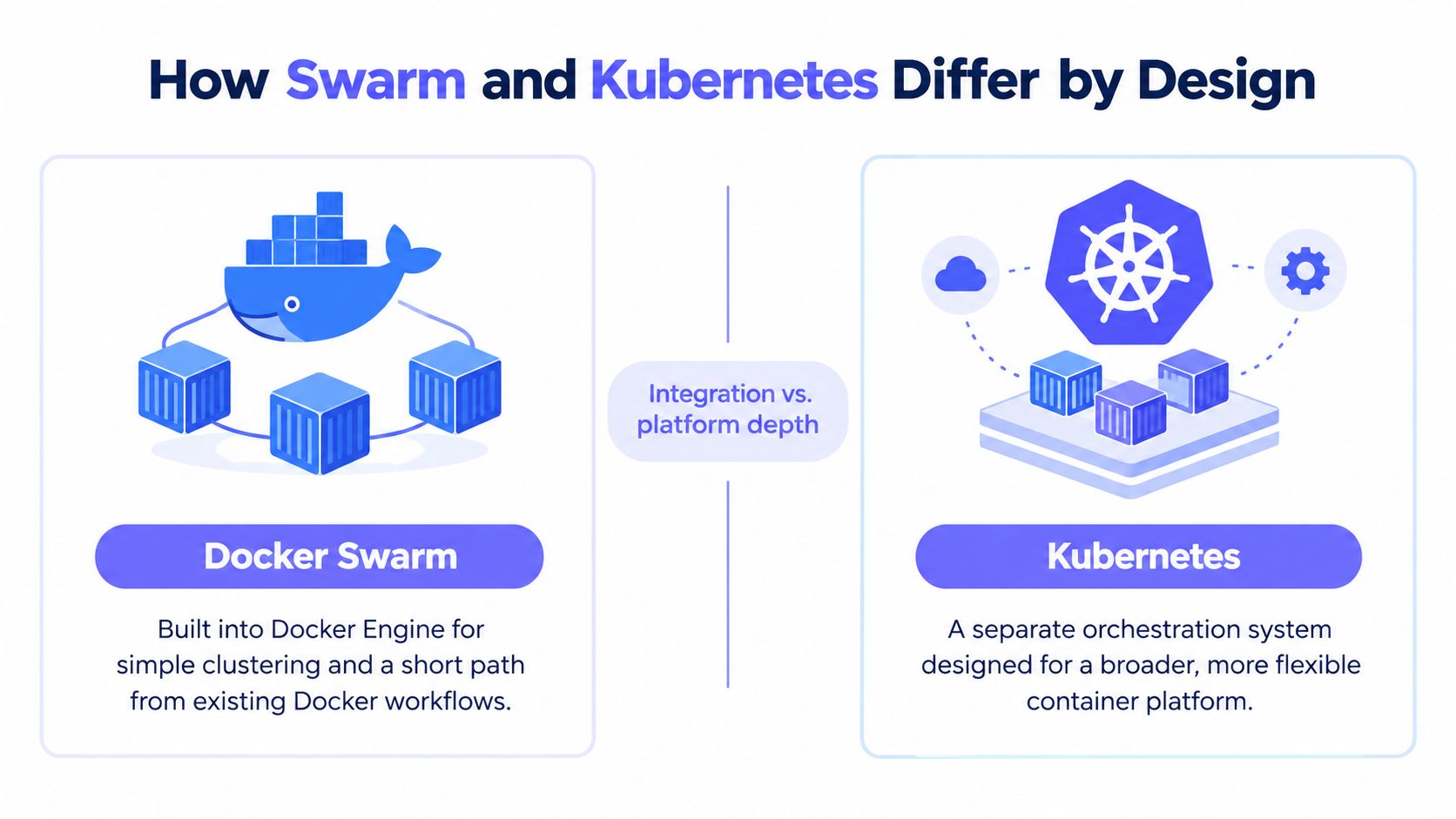
Integration versus platform depth
Swarm's advantage is a compact path from Docker workflows to clustered services. That can reduce setup friction for Docker-centric teams. Kubernetes offers a wider control plane and more extensive automation, which can be valuable when services, infrastructure, or operational needs are more varied. In practice, one platform emphasizes integration and simplicity; the other emphasizes control and orchestration depth.
That difference shapes how teams reason about deployments. A Swarm operator can stay closer to familiar Docker concepts, while a Kubernetes operator must account for its own object model and desired-state workflows. Teams exploring declarative operations may also find it useful to understand how GitOps applies to infrastructure and application management.
Neither design is a universal advantage. A smaller control surface can make routine work easier, but it may not provide the automation or flexibility a more demanding environment needs. A broader platform can address more operational cases, but only if the team can support its added components and practices.
Scalability, Networking, and Storage Compared
The most important differences become concrete when teams examine scaling, traffic routing, and persistence. Kubernetes offers more extensive autoscaling and automated recovery, while Swarm's simpler model can suit stable services that don't need as much orchestration depth. That distinction matters when workload demand changes often or a team needs the platform to react to failures and shifting resource needs.
| Dimension | Docker Swarm | Kubernetes |
|---|---|---|
| Scaling | Explicit replica count and task reconciliation; metric-driven scaling needs added automation | Horizontal Pod Autoscaler can adjust replicas from configured metrics; metrics collection and node capacity still need configuration |
| Networking | Overlay networking and routing-mesh behavior | Services and Ingress, with different operational assumptions |
| Storage | Stateful services need deliberate volume planning | Persistent volumes still require workload-specific planning |
Kubernetes Horizontal Pod Autoscaling is a configured control loop, not automatic capacity on installation. Resource metrics usually need Metrics Server, CPU utilization targets depend on resource requests, and extra replicas still need schedulable nodes. Test what happens when the cluster is full.
Networking and persistence require separate scrutiny
Swarm's overlay networking and routing mesh don't map directly to Kubernetes Services and Ingress. A migration therefore involves more than rewriting deployment definitions: operators must check how traffic reaches services, how discovery works, and how external routing is configured. The operational assumptions behind the existing network need to be documented before translation begins.
Neither platform replicates application data merely because it replaces a container. With Swarm’s default local volume driver, a task rescheduled to another node can encounter a different or empty volume; see Docker service storage. Kubernetes persistent volumes depend on the chosen storage implementation and access modes; a StatefulSet is not a database replication or backup system. Define data placement, consistency, restoration, and failure-domain behavior before testing failover.
Measure both platforms with the same application image, CPU and memory allocation, ingress/TLS path, dataset, and offered load. A comparison between a tuned managed service and an untuned local cluster cannot isolate orchestrator overhead.
Evaluate latency, errors, recovery time, capacity cost, and operator effort together. Lower latency does not compensate for lost data or a recovery procedure the team cannot execute.
Reading Performance Benchmarks Without Overreacting
There is no defensible universal throughput winner. Record results from a production-shaped pilot rather than extrapolating old benchmarks with different request counts, concurrency, and infrastructure.
| Test | Hold constant | Acceptance criterion to set before testing |
|---|---|---|
| Steady load | Request mix, dataset, ingress, resource limits | p95/p99 latency and error rate remain within the service target |
| Traffic increase | Offered request rate and duration | Capacity arrives before the agreed queue or latency limit |
| Worker loss | Replica placement and spare capacity | Service resumes within the recovery budget without data loss |
| Deployment rollback | Same incompatible test release | Previous version serves correctly and data remains compatible |
| Control-plane disruption | Failure-domain model | Existing traffic and administration behavior are understood |
Record warm-up time, repetitions, client-side errors, and infrastructure cost. Do not confuse total requests with simultaneous users.
Benchmark the workload, not the headline
These results vary because applications, infrastructure, network paths, and cluster configuration vary. A benchmark that measures a simple web request may not reveal how the same platform behaves when storage, service discovery, recovery, or ingress becomes part of the path.
A useful evaluation keeps the application and test conditions as consistent as possible while changing the orchestrator. Teams should exercise production-like ingress, service discovery, storage, failure recovery, and autoscaling, then compare response behavior and resource use under both normal and stressed conditions. They should also record what the test doesn't measure, such as the time operators spend troubleshooting or maintaining the environment.
Practical rule: Treat published results as hypotheses for a local test, not as production guarantees.
A platform can perform well in a focused benchmark and still impose an operational burden the team can't sustain. Conversely, a simpler setup may be a sensible choice when its measured behavior and operating model meet service requirements.
Operational Complexity, Monitoring, and Day-Two Work
The first deployment is only the beginning of operating an orchestrator. Teams must handle upgrades, security policy, troubleshooting, and monitoring after services are running. Kubernetes' control-plane capabilities bring more operational decisions; Swarm's smaller surface area can reduce cognitive load for teams with limited platform capacity.
Monitoring needs to cover both the infrastructure and the application behavior that matters to service owners. Teams commonly assemble observability from metrics, dashboards, and alerting tools, then spend time maintaining that stack. The specific setup matters less than achieving observability parity: before a platform change, operators should know which signals, alerts, and incident workflows must continue working afterward.
A migration can otherwise appear healthy while important visibility disappears. If the current environment tracks container resource use, host health, website availability, and scheduled jobs, the new environment should preserve those views or replace them deliberately. Teams evaluating their tooling can review approaches to monitoring Kubernetes environments.
A practical day-two sequence
Upgrades and security policy come first. Operators need a repeatable way to keep the platform and its components current, and a clear understanding of who can deploy or alter services. The exact work differs by orchestrator, but neither platform eliminates the need for ownership and change control.
Troubleshooting depends on usable signals. Operators need to connect an application symptom to the relevant service, container, host, or network condition. A dashboard that shows infrastructure without helping the team isolate incidents won't substitute for a working response process.
Monitoring choices should match the coverage required. Fivenines provides Docker and host monitoring, external uptime checks, and notification workflows. These do not by themselves establish Kubernetes API, controller, or etcd coverage: retain cluster-specific monitoring until a pilot demonstrates equivalent signals. Supported Fivenines destinations include PagerDuty and webhooks; SMS is not a native channel. Check current plan terms instead of relying on a starting price copied into a comparison.
Swarm managers require a majority for quorum: three managers can tolerate one unavailable manager, while five can tolerate two. Losing quorum prevents control-plane updates even if existing tasks keep running. Use the Swarm administration guide to plan fault domains and tested recovery; never interpret surviving containers as a healthy control plane.
The orchestrator decision should remain separate from the monitoring decision. Teams need reliable visibility whichever platform they choose, and operational simplicity is meaningful only if incidents can still be detected and investigated.
Use Cases and Migration Risk for Existing Swarm Stacks
A solo operator running a stable service may prefer Swarm because familiar Docker workflows can keep routine operations manageable. A small SaaS team with limited platform-engineering capacity faces a similar trade-off: Kubernetes may offer useful future flexibility, but that value must justify the training and support burden now.
An MSP or hosting provider managing many environments has a different concern. Consistent operations and visibility across clients can matter as much as the orchestration features of any individual cluster. A platform team responsible for heterogeneous workloads, changing demand, and automated recovery may find Kubernetes' broader model more valuable, provided it can staff and maintain that model.

Migration is an operational change, not an image conversion
Container-image portability doesn't equal operational portability. Swarm overlay networking and routing-mesh behavior differ from Kubernetes Services and Ingress. Docker secrets and configs also map imperfectly to Kubernetes Secrets and ConfigMaps, so teams must revisit how configuration and sensitive data are managed. Stateful services such as databases and message queues need separate storage and recovery planning.
Operators also have to learn Kubernetes concepts such as Pods, Deployments, Helm, and kubectl. That learning takes time away from other work and can affect incident response while the team builds experience. A useful migration plan makes that cost visible instead of treating it as an incidental implementation detail.
Before moving a service, assess:
- Service criticality: What is the impact if the service behaves unexpectedly during migration?
- Statefulness: How will persistent data, databases, or message queues be handled?
- Networking dependencies: Which routing, discovery, or connectivity assumptions must change?
- Rollback strategy: What is the tested path back if the new deployment fails?
- Observability parity: Will operators retain the signals and alerts they rely on?
- Business case and training: Does the expected benefit justify retraining and ongoing platform work?
An incremental migration can reduce the scope of each change, but it can also create a period in which teams operate both platforms and duplicate some processes. That risk should be planned for, not assumed away. Teams can document their existing deployment and monitoring practices with a guide to building a monitoring stack with Docker Compose, then decide which practices need to carry across.
The key question is not whether an incremental move is possible. It's whether each stage has clear ownership, usable monitoring, and a rollback path, without leaving the team responsible for two operational models indefinitely.
Making the Call and Your Next Practical Step
The recommendation depends on the work the team needs to do, not on a universal ranking. Choose Docker Swarm when the team is Docker-centric, the service topology is stable, the workload is moderate in scale, and minimizing setup and operational overhead matters most. Choose Kubernetes when the environment needs deeper orchestration, more extensive automation, metrics-based scaling, extensible controllers, or broader policy requirements, and the team can support its learning and day-two requirements.
Kubernetes also benefits from a broader ecosystem and hiring base, which can matter as a team or platform grows. That advantage is strategic rather than automatic: it doesn't make the migration cost disappear, and it doesn't prove a simpler workload needs a more complex platform. A Swarm stack that meets its service requirements shouldn't be moved solely to follow adoption trends.
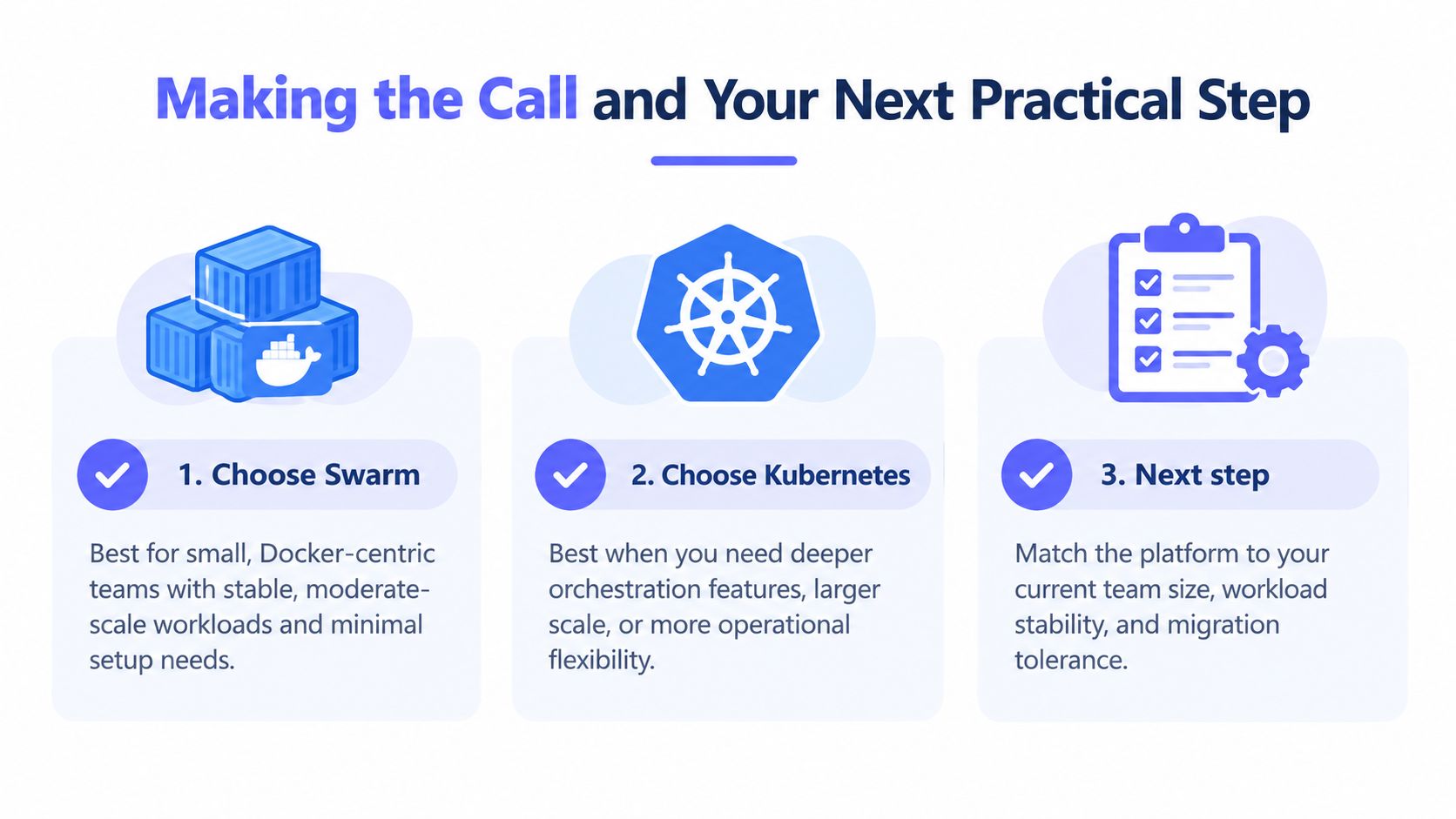
Use a workload-based checklist
Before committing to a platform or migration, check:
- Service count and complexity: Are services straightforward and stable, or do they need more scheduling and automation?
- Statefulness: Do persistent data and recovery requirements fit the current operating model?
- Growth expectations: Is demand predictable, or does the workload require more flexible scaling?
- Platform capacity: Can the team handle upgrades, security, troubleshooting, and training?
- Monitoring coverage: Can operators compare service and infrastructure behavior before and after a change?
The next step is to establish a baseline on the current cluster. Record the service SLO, failover results, platform-specific alerts, and operator time. Keep both old and new monitoring during a migration, then retire an old check only after the corresponding failure test succeeds in the replacement.
Fivenines combines server and container metrics, uptime monitoring, cron job tracking, and alert routing in one infrastructure monitoring platform. Before migrating from Swarm or adopting Kubernetes, visit Fivenines to establish the visibility needed to compare the platforms against your own workloads.