Datadog Feature Flags: A Practical Guide to Safer Releases

An on-call engineer has an error-rate alert, a recently released checkout change, and a customer asking whether everyone is affected. The deployment succeeded, but that doesn't answer the operational question: can the team withdraw the new behavior from the affected customer without disturbing anyone else? That's where Datadog Feature Flags deserves attention, and where a working toggle needs a much stronger production operating model.
Table of Contents
- The 2am Rollout Problem
- What Datadog Feature Flags Actually Are
- How Local Evaluation Changes the Trade-Offs
- Targeting Keys and Percentage Rollouts
- Connecting Flags to Observability Signals
- The Governance Gap Most Teams Miss
- How It Compares to Standalone Feature Management
- A Practical Implementation Checklist
The 2am Rollout Problem
Consider a hypothetical incident in a shared SaaS application. A team enables a new checkout path for selected customers, then sees payment failures. The responder finds the release flag, but its targeting rule combines customer attributes with a broader rollout condition.
Disabling the whole flag might restore service. It might also remove a working feature from unrelated customers, interrupt an experiment, or expose an older code path that nobody has recently exercised. Rolling back the deployment introduces a different question: does the previous application version still work with the current data?
The hard part isn't locating a switch. It's knowing what the switch controls, who receives the resulting behavior, and whether the reversal is safe.
Deployment and release are different decisions
A deployment places code into an environment. A release makes behavior available to an audience. Teams should treat a feature flag as a release-control surface, not as a substitute for deployment tooling or backward-compatible application design.
In the checkout example, a useful incident procedure would distinguish among these actions:
- Withdraw exposure: Return the affected customer to the established checkout path.
- Revert application code: Replace the deployed implementation when flag control cannot contain the fault.
- Repair state: Address changes that switching behavior cannot undo, such as an already-submitted transaction.
The responder also needs clear authority to act. A documented approach to incident response best practices should identify the decision owner, the communication channel, and the evidence required before declaring recovery.
Operational test: A rollback procedure isn't ready until another engineer can execute it without guessing which customers it affects.
Datadog's appeal is the possibility of investigating release behavior alongside operational telemetry. Before trusting that workflow, however, teams need to validate audience selection, application-side evaluation, access boundaries, and the actual reversal procedure. A visible release is easier to investigate, but visibility alone doesn't make it safe.
What Datadog Feature Flags Actually Are
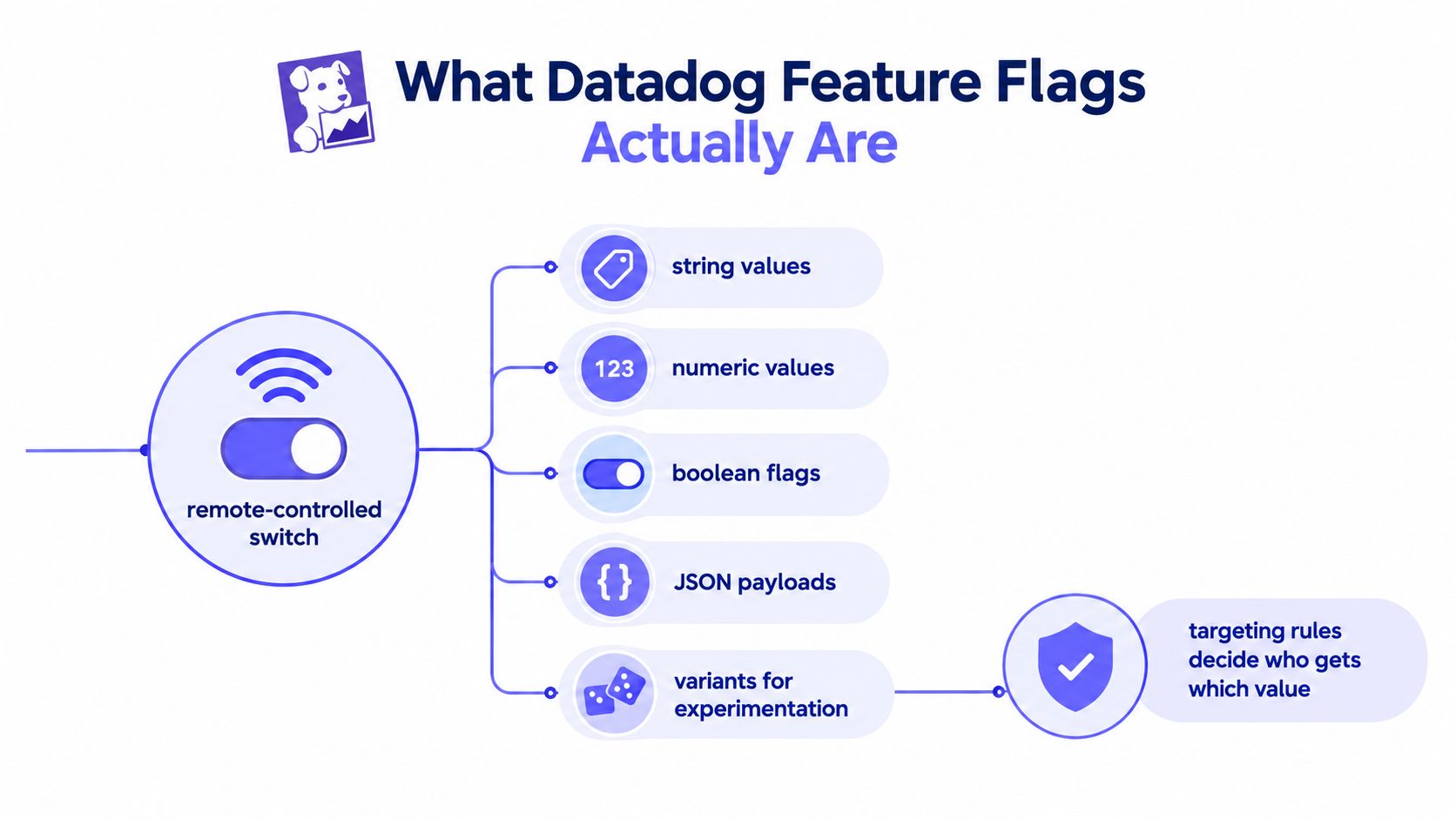
The simplest mental model is a remote-controlled switch. Application code asks for a flag value, then chooses behavior based on the answer. Changing the flag changes which behavior the application selects, without requiring another code deployment for that decision.
Datadog Feature Flags reached general availability on February 3, 2026, with an architecture connecting flag evaluations to Application Performance Monitoring (APM) and Real User Monitoring (RUM), according to the Datadog launch announcement. The important distinction is release control connected to operational evidence, rather than configuration maintained in isolation.
The diagram introduces the relationship between values and targeting.
Values represent application choices
Datadog documents five value categories and a version-2 feature-flags API, including flag creation and starting progressive-rollout exposure schedules, in its feature flags getting-started documentation.
| Value category | Illustrative application use |
|---|---|
| Boolean | Select the established or replacement checkout path |
| String | Choose a named recommendation strategy |
| Integer | Select an application-defined processing limit |
| Numeric, float or double | Tune an application parameter |
| JSON | Supply structured settings for a controlled feature |
These are examples of application design, not ready-made product workflows. The application must interpret each returned value and handle unexpected input safely. A JSON payload, for example, still needs validation before application code uses it.
API-managed control also means a release workflow needn't depend entirely on someone clicking through a console. Teams can design automation around explicit flag actions, subject to their own review and authorization requirements.
The boundary matters: typed flag values don't make a feature-flag service a general-purpose configuration system. Secrets, durable business records, and settings with unrelated lifecycle requirements should remain separate architectural decisions. Flags fit best where a team needs to control exposure, select behavior, or compare alternatives while retaining an understandable reversal path.
How Local Evaluation Changes the Trade-Offs
A responder disables a flag at 2 a.m. mid-incident. The console confirms the change within seconds. Fifteen minutes later, one tenant is still hitting the new code path, and nobody can tell whether the fix failed or hasn't arrived yet.
That ambiguity is the price of local evaluation. The application doesn't ask a remote service for a decision on each lookup. It receives configuration, stores it, and evaluates rules inside its own process. Every running process holds its own copy of flag state, and copies can lag.
Datadog documents this server-side model alongside agentless SDK versions for Node.js, dd-trace 6.12.0; Python, ddtrace 4.14.0; and .NET, dd-trace-dotnet 3.54.0 with Datadog.FeatureFlags.OpenFeature 2.3.1 in its server-side feature flags documentation. Treat those numbers as compatibility checkpoints to verify in staging, not as approval to upgrade production instrumentation untested.
The diagram shows the separation between configuration delivery and application-side decisions.
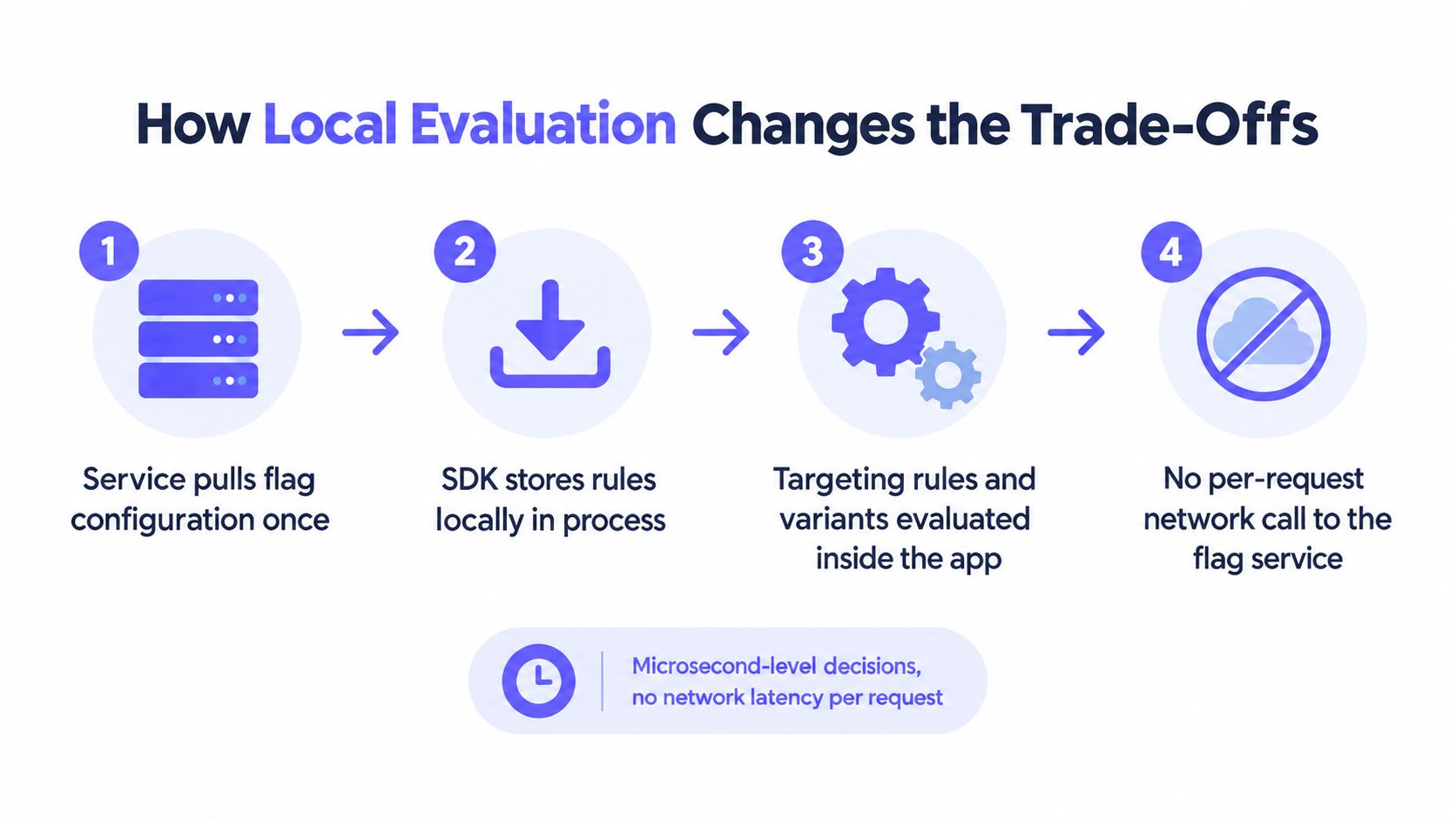
The payoff is concrete. No network call sits on the request path, so a control-plane slowdown cannot stall flag lookups mid-request. The bill arrives elsewhere: freshness becomes the team's responsibility. Configuration isn't fetched once at boot and forgotten, and a saved change in the console is not proof that every process has applied it. Refresh behavior has to be verified for the specific SDK and deployment in use.
Four moments determine whether this model holds up during an incident, and each deserves an explicit answer in the runbook.
Startup: what the application serves before usable configuration becomes available.
Refresh failure: how a running service behaves when updates stop arriving.
Evaluation failure: the fallback for a missing flag, invalid context, or an incompatible value.
Version changes: whether the tracer and flag-provider packages are pinned and tested together.
Fallback semantics are easy to get wrong. For a payment feature, "safe" may mean the established processing path rather than a default of false. The right answer depends on what each application considers harmless.
The accompanying video covers the release workflow in another format.
Local evaluation removes a request-time dependency. Configuration freshness, startup behavior, and recovery testing remain the team's job.
A staging drill worth scheduling: interrupt configuration access while traffic keeps flowing, then watch what the service does. The result is often surprising.
Targeting Keys and Percentage Rollouts
Say a portal team releases a new billing view to 10% of traffic. The percentage is the easy part. The harder question sits underneath it: 10% of what? Users, devices, sessions, and tenants each produce a different rollout, and the console cannot pick that unit for the team.
Datadog uses a persistent targetingKey for consistent bucketing and supports flat string, number, and Boolean attributes for targeting rules, as described in its feature flags documentation. The key works like the input to a hash function: the same key lands in the same bucket every time. Attributes describe the subject's properties and feed the rules that decide eligibility.
Those two roles often get conflated. In a multi-tenant customer portal, a user identifier supplies continuity, a tenant attribute determines eligibility, and a region attribute can narrow exposure further. Merge them into a single field and the rollout loses the stable subject it was supposed to hold.
A request ID fails as a key for an obvious reason: every call presents a new one, so one person drifts between variants mid-session. The subtler version is inconsistent identity across services, where the frontend buckets by user while the backend buckets by a regenerated session ID. Both decisions can be locally correct while describing no coherent customer at all.
Before raising the percentage, pin down a targeting contract:
| Contract item | What to decide |
|---|---|
| Rollout unit | Whether the subject is a user, device, session, or customer, and why |
| Identity source | Where the key originates and how services pass it between calls |
| Attribute schema | The field names and types the policy depends on, nothing more |
| Stability check | Repeated evaluations for one subject return the same variant |
For an MSP, tenant identity earns an extra line in that contract. A targeting key names the rollout subject and nothing more: authorization stays with the application, which still decides which customer resources a request may reach.
That contract is what turns "10%" into a controlled canary instead of a cosmetic number.
Connecting Flags to Observability Signals
A responder opens the checkout dashboard after an error spike and sees a flag change sitting on the timeline a few minutes before the spike began. That placement narrows the search. The working question becomes whether the failing requests received the new variant, because the timeline alone cannot separate coincidence from causation.
Datadog records change events for edits to targeting, rollout, or status, and each event carries the environment, the actor, previous and new values, targeting rules, and variants. The feature-flag change-tracking documentation also describes identifying affected services through tracing and placing those events on operational timelines, so flag state travels with the rest of the incident record.
From there, the investigation runs like any other, with exposure added as one more signal. Start with the change event to pin down which environment and settings moved. Compare the evaluated variants against service errors and page behavior: APM covers the service path, RUM covers what users saw, and real-time exposure information supplies the audience context for both. Then check the boring explanations. Shared dependencies, traffic shifts, and an unrelated deploy can all produce the same shape on a graph.
That rigor is the same discipline behind monitoring application performance: annotation helps, yet it cannot compensate for missing instrumentation or an alert blind to the customer-visible failure. When the exposure data itself looks questionable, Visbanking on data observability covers how to evaluate whether the underlying information deserves the trust a dashboard comparison implies.
Evidence boundary: A timeline can establish that a change happened before a regression. Engineers still need to investigate whether the changed behavior caused it.
Reconstruct the incident this way, and the flag record has done its job.
The Governance Gap Most Teams Miss
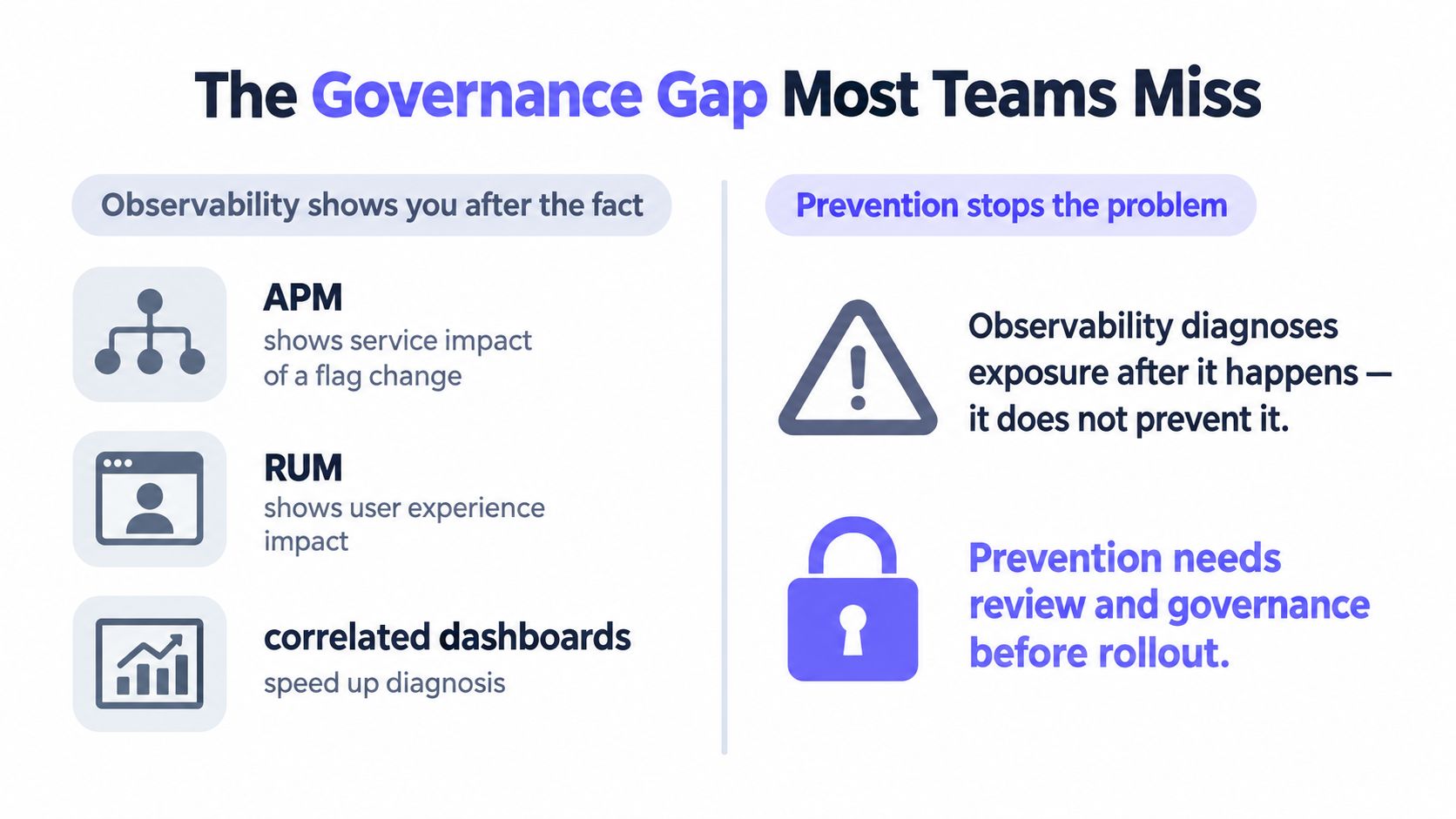
Seeing a flag in a trace is not the same as controlling who may change it. Observability supports diagnosis after exposure. Governance determines whether an engineer can accidentally expose the wrong customer, environment, or region in the first place.
Small teams need this distinction as much as large organizations. An MSP operator may manage several customers while working from the same interface. A technically valid edit can still be operationally wrong if it selects a broader audience than intended.
The comparison below separates investigation from prevention.
Define the authority to change exposure
Teams should establish a written operating model rather than infer safety from available controls. Datadog's documented API actions and change records provide useful building blocks, but they shouldn't be mistaken for proof of tenant isolation, reviewed promotion, or drift reconciliation.
The operating model should specify:
- Isolation boundaries: Separate customer and environment scopes wherever supported, and test that rules cannot unintentionally overlap.
- Least privilege: Distinguish routine viewing, release administration, and emergency intervention. Verify actual permission granularity before relying on it.
- Approval evidence: Record the intended audience, expected behavior, and authorized reversal action.
- Lifecycle ownership: Give each flag a responsible team, a naming convention, and a removal condition.
- Emergency access: Define a break-glass path with restricted access and mandatory review afterward.
Release criteria should also connect to an explicit service-level objective. The responder needs a meaningful definition of unacceptable impact, not an instruction to watch dashboards until something looks wrong.
Rehearse the tenant-specific reversal
A useful drill asks an unfamiliar responder to withdraw exposure from a designated test tenant while leaving another unchanged. The exercise should verify permissions, rule precedence, application behavior, and the evidence used to confirm recovery.
Teams managing flags through automation also need a declared source of truth. Otherwise, an emergency console edit may later be overwritten by routine reconciliation. Drift detection, promotion between environments, and rollback testing require explicit design and validation.
The standard should be concrete: an authorized engineer can reverse the intended behavior, for the intended audience, with a reviewable record.
How It Compares to Standalone Feature Management
Datadog Feature Flags should be evaluated against a team's release requirements, not against an assumption that consolidating tools is always better. A team already using Datadog has a clear reason to investigate its integrated workflow. That doesn't settle questions about commercial terms, permissions, experimentation, or environment promotion.
Dedicated platforms such as LaunchDarkly and Split belong in the evaluation. Their presence in a shortlist isn't evidence that every required capability is available in every plan or deployment model.
Datadog Feature Flags vs Standalone Feature Management
| Dimension | Datadog Feature Flags | Dedicated platforms (LaunchDarkly, Split) |
|---|---|---|
| Operational context | Designed around Datadog-linked release and observability workflows | Evaluate how flag context reaches the existing monitoring stack |
| Data placement | Review flag and telemetry handling within the proposed Datadog setup | Review the additional platform's storage, residency, and export terms |
| Pricing | Request terms matching expected usage | Compare equivalent targeting, usage, and experimentation requirements |
| Governance | Validate permission scope and customer boundaries | Test the same approval and isolation requirements |
| Environment promotion | Prove the intended API-driven workflow | Require a demonstration of promotion and drift handling |
| Experimentation | Validate suitability for the intended experiment design | Compare analysis capabilities against concrete requirements |
Choose through a production-shaped trial
A useful evaluation uses the same application scenario across candidates. The team should demonstrate a tenant-scoped release, an unavailable configuration source, an emergency reversal, and an audit review. Marketing checklists cannot establish whether an on-call engineer can perform those tasks safely.
Commercial evaluation should follow that demonstration. Without verified pricing and plan details, a defensible comparison cannot claim that either approach is cheaper.
The practical recommendation is conditional. Datadog is a credible candidate when release decisions belong close to existing telemetry. High flag volume, complex targeting, or demanding experimentation requirements justify a serious standalone evaluation, but they don't automatically establish a winner.
A dedicated platform earns its place when the team can demonstrate that it satisfies necessary requirements better, at an acceptable operational and commercial cost. Consolidation is useful only when it preserves the controls the team needs.
A Practical Implementation Checklist
A first production rollout should be deliberately unremarkable. Teams should choose a reversible behavior with clear ownership, a known established path, and an audience whose exposure can be checked directly. A shared application migration is a poor place to discover undocumented evaluation behavior.
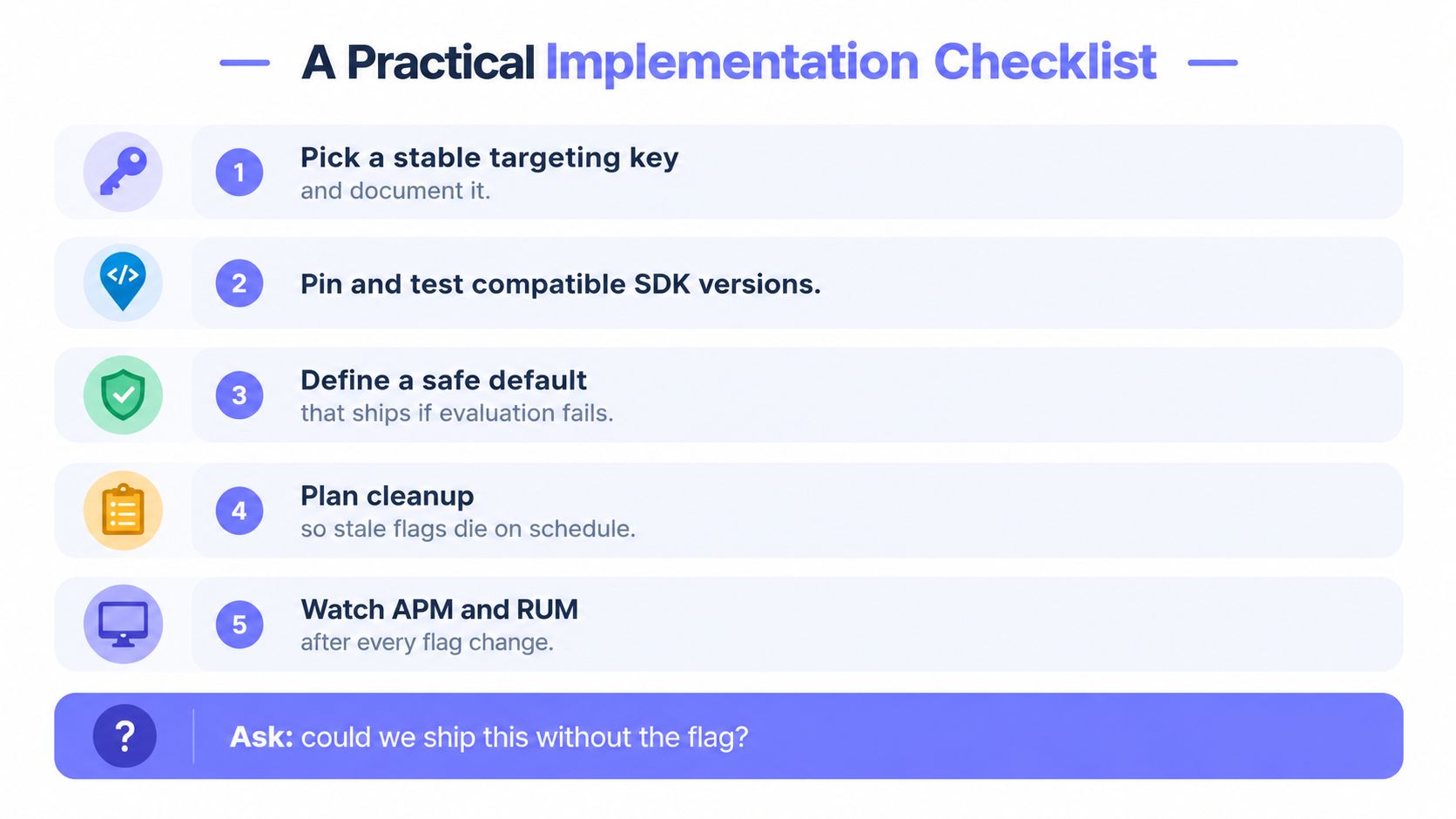
The checklist summarizes the implementation work that should precede broader adoption.
Make readiness demonstrable
The release owner should collect evidence for each item rather than accept verbal confirmation:
- Targeting contract recorded: Identity, required attributes, and missing-context behavior have been reviewed.
- SDK combination tested: The deployed packages are pinned, and startup and upgrade behavior have been exercised.
- Fallback verified: The application follows the intended safe path when evaluation cannot return a usable result.
- Refresh policy established: Operators know how to identify stale configuration and confirm delivery of a corrective change.
- Incident workflow connected: Responders can move from an alert to the relevant release record and authorized action.
- Cleanup scheduled: Each flag has an owner and a condition for removing both configuration and obsolete code.
- Rollback rehearsed: A tenant-specific reversal has been executed and its boundaries checked.
Automation should preserve this evidence rather than bypass it. The principles behind monitoring automation apply to repeatable checks, routing, and response workflows, but automated actions still need explicit scope.
Decide what the team actually needs
A team should pause adoption if it cannot identify the release problem a flag solves. Straightforward deployment and rollback may be sufficient for some changes; others warrant a dedicated feature-management evaluation or better infrastructure visibility before release automation.
A flag's value comes from the operational model around it, not the toggle itself.
Fivenines offers infrastructure monitoring that brings Linux server metrics, network device health, website uptime, and cron job tracking into a single dashboard. Teams strengthening release runbooks can visit Fivenines to evaluate the underlying infrastructure signals and alert workflows alongside their chosen feature-management system.