Incident Escalation Process: How to Design One That Works

The outage channel is busy, the primary responder hasn't acknowledged, and someone has asked whether the latest deployment should be rolled back. Engineering is investigating. Support wants a customer update. Nobody has said who can authorize the rollback or whether a reporting deadline has started.
An incident escalation process should resolve those questions, not just send another page. A useful policy names the next responder, the decision that person owns, and the clock that determines when responsibility moves.
Table of Contents
- Escalation Timers by Severity at a Glance
- How to Build the Escalation Workflow Step by Step
- Assign Roles and Decision Authority
- Design On-Call Rotations and Automated Fallbacks
- Tie Runbooks to Rollback and Change Triggers
- Handle Major Incidents With a Regulatory Clock
- Pilot the Process on Your Next Real Incident
Escalation Timers by Severity at a Glance
A severity-to-timer matrix tells responders how long they have before another person gets paged and which authority becomes involved.
Every minute a page sits unacknowledged, the blast radius grows: more customers hit the failure, more dependent systems retry, and the eventual fix happens under more pressure. Delayed escalation also burns the one resource you cannot replenish mid-incident, the time left on a reporting or rollback clock.
A starting policy, not an industry benchmark
The deadlines below are proposed operating defaults, not measured success thresholds or prescribed NIST deadlines. The impact descriptions adapt the NIST-style functional-impact approach to a production-service policy.
| Severity | Impact (NIST-style) | Acknowledge within | Escalation path |
|---|---|---|---|
| SEV1 | Critical service unavailable to all users | 5 minutes | Page secondary at 5 minutes, incident commander at 10 minutes, executive duty officer at 20 minutes |
| SEV2 | Critical service unavailable to a subset of users | 15 minutes | Page secondary at 15 minutes, incident commander at 30 minutes |
| SEV3 | Critical services available, noncritical function degraded | 1 business hour | Ticket to owning team, page only if unacknowledged after 4 hours |
| SEV4 | Single-user or cosmetic issue without wider critical impact | Next business day | Ticket only, no paging |
All elapsed deadlines run from severity assignment, not from the previous escalation. Acknowledgement stops the no-response chain, but it doesn't cancel separate investigation or decision deadlines. An acknowledged page with no decision owner still stalls.
Raw alert noise shouldn't start the classified-incident timer. Detection and awareness timestamps must remain visible, though, so slow triage doesn't disappear from reporting. Real-time alerting should deliver evidence quickly enough for that classification to happen promptly.
Teams adopting this matrix should name a person for every escalation step, define the business-hours calendar, and schedule a review after an initial month of incidents. When I audit these policies, the gap is almost never the paging chain. It's the missing decision at each step. Write the decision next to the name: who can authorize a rollback, who approves customer communication, who declares the incident over.
How to Build the Escalation Workflow Step by Step
A 3 a.m. page fails in a predictable way: the responder is tired, the first diagnosis is wrong, and the handoff message says only that a check failed. Build the workflow so the next person gets the service, symptoms, impact, clock, and decision owner in one record.
NIST's incident-handling guidance supplies useful vocabulary and a repeat-contact example of roughly 15 minutes. The severity matrix supplies production deadlines. Use the matrix titles throughout: incident commander is the decision lead, and executive duty officer is the named higher authority. Its functional-impact axis is none, low, medium, and high: none means no effect on service delivery, low means critical services still reach all users with reduced efficiency, medium means a critical service is lost for a subset of users, and high means some critical services cannot be provided to any users. In the matrix, high impact reads like the SEV1 row, medium like SEV2, low like SEV3, and none fits SEV4 only when the effect is cosmetic or limited to a single user.
From incoming signal to accountable response
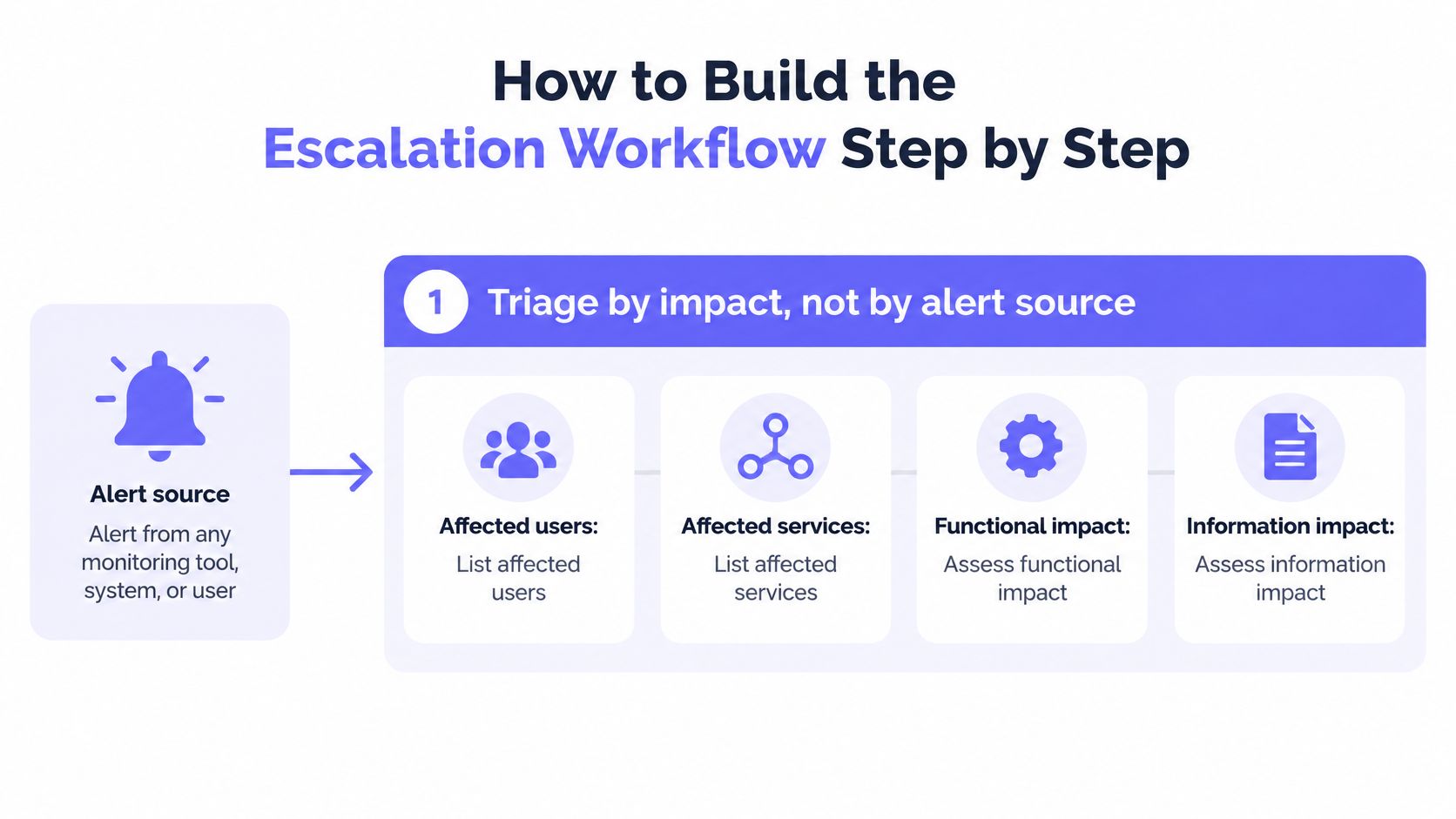
Triage by impact, not alert source. Record affected users and services, functional impact, information impact, and likely recoverability. Mark the NIST-style impact level first, then translate it into the matching SEV row so “critical service unavailable to all users” maps to SEV1 instead of sitting as an unlabeled “high.”
Assign severity and record the reasoning, owner, and timestamp in a single incident record. A provisional classification is acceptable when facts are incomplete, provided the record distinguishes observations from assumptions.
Start the response timer at assignment. The matrix supplies the acknowledgement deadline, while the service runbook supplies an investigation timebox. Recording both prevents an acknowledged incident from remaining indefinitely with a responder who cannot make progress.
Page the primary with the affected service, observed symptoms, impact, incident record, and runbook. A bare notification forces the responder to reconstruct context before investigating.
If acknowledgement does not arrive, retry the primary once inside the same acknowledgement window. That retry does not extend the clock. At the matrix deadline, page the secondary even if the retry just went out; under SEV1 policy, a failed call can be retried by SMS immediately and the secondary still gets paged at 5 minutes from assignment.
If the secondary also misses the deadline, follow the matrix path by name: page the incident commander at the next deadline, then involve the executive duty officer when the commander is unreachable or the action needs authority beyond the commander's delegated limit. Change contact route after a channel fails instead of repeating pages into silence.
Log response escalation separately from authority escalation. Response escalation adds specialists or capacity. Authority escalation asks the incident commander or executive duty officer for permission to take a consequential action. The record should say which gap the incident has: knowledge, capacity, or permission.
Reassess severity at predefined investigation checkpoints and whenever material evidence changes. Record the previous classification, new classification, reason, and decision-maker rather than editing the incident label without documenting the change.
Keep the impact assessment visible beside the incoming alert.
Keep the workflow executable
These steps belong in the response tooling, not just a policy document. The incident record should expose the current owner, next deadline, and next action without requiring someone to search a separate spreadsheet.
Practical rule: An acknowledgement proves that someone saw the page. It does not prove that a capable responder owns the incident.
The same distinction belongs in broader incident response practices. Severity based only on alert count and repeated paging through an unavailable channel both create activity without establishing useful ownership.
Assign Roles and Decision Authority
Ownership ambiguity deserves the same attention as failed notifications. In Cytactic's incident-response management report, 41% of organizations reported delayed critical actions because final authority was unclear, 86% reported costly translation time between technical, legal, and communications teams, and 44% experienced communication breakdowns during incidents.
Cross-functional coordination needs an explicit operating model.

Separate work ownership from decision authority
The following role design gives each responsibility an accountable owner. Smaller teams can combine roles, but the incident record should still identify who holds each responsibility.
| Role | Owns | Hands off when |
|---|---|---|
| Incident commander | Final call on priority, scope, and risky remediation within delegated authority | A higher authority explicitly assumes the decision, named in the log |
| Technical lead | Diagnosis and fix path | Diagnosis exceeds its timebox, then the service owner takes responsibility |
| Communications owner | Internal and customer updates from approved templates | Legal or regulatory review is required before publishing |
| Decision-log keeper | Single timeline of facts, decisions, and timers | The incident closes and the log passes to the postmortem owner |
The commander needs predelegated authority, not unlimited authority. Engineering leadership, security, and legal should agree beforehand which actions require separate approval and who breaks a deadlock.
For example, the technical lead may recommend restoring a database snapshot while security objects because it could overwrite evidence. The commander should apply the documented decision boundary and obtain the required approval, not settle the disagreement by counting opinions.
Make transfers explicit
A valid handoff records the outgoing owner, incoming owner, scope of authority, and incoming owner's acceptance. Mentioning a senior engineer in Slack isn't an authority transfer.
Adding recipients can make response worse when each person assumes another person owns the decision. That risk is especially relevant to SaaS teams, MSPs, and hosting providers, where technical remediation, tenant communication, and contractual obligations may have different owners.
This video provides an additional discussion resource for response coordination.
Before the next incident, the policy should answer concrete questions: Who approves rollback? Who authorizes customer messaging? Who can declare the incident over? A role title without those decision rights leaves the central problem unresolved.
Design On-Call Rotations and Automated Fallbacks
A hosting team's primary responder gets paged at 3 a.m. during a database outage. Her phone is dead. The monitoring system reports the notification as delivered, the acknowledgement window ticks down, and nobody with access to the production cluster knows an incident exists. The question that matters is not whether the page fired. It is whether a second human received actionable context before the clock ran out.
NIST's incident-response guidance treats staffing and communication arrangements as part of response capability, so unavailable responders are a scenario worth planning for rather than an edge case. Revision 2 was withdrawn on April 3, 2025, and superseded by Revision 3, so teams should treat its examples as historical guidance rather than the current standard.
Remove the person-shaped single point of failure
- Named coverage: Every production service needs a primary and secondary who can access the systems they may need to repair.
- Deliberate handoffs: A weekly rotation is a reasonable trial design, not a universal staffing rule. The handoff should cover active incidents, risky changes, temporary suppressions, and access problems.
- Independent channels: Pair an application notification with another route, such as SMS, and consider a phone call for the highest urgency.
- Coverage-gap behavior: Empty schedules should route immediately to an explicit fallback rather than wait for an unavailable responder.
SMS alerts give you a route that does not depend on a chat client being open, but they share failure modes with everything else on the same handset. A dead phone kills push notifications and SMS alike. That is why testing needs to simulate unavailable devices and unreachable responders, not just confirm a message reached someone already watching the channel.
The deeper issue is who owns the fallback decision. If the secondary acknowledges but lacks authority to act, you have moved the page, not the incident.
Automate the policy without automating noise
A monitoring workflow can implement routing, delays, retries, and escalation. Available destinations may include Slack, Microsoft Teams, Telegram, Discord, email, SMS, Pushover, and webhooks; the operational choice is which combination remains usable during the failure being handled.
Multi-region failure confirmation can screen out isolated monitoring failures before paging. It should not suppress a genuine regional outage just because another location still works.
Quiet-hours rules belong in the same category. Send low-urgency work to an agreed queue while preserving urgent exceptions, and give maintenance windows owners and expiry conditions so a temporary suppression cannot become a permanent blind spot.
A fallback is only independent if the original failure can't disable it too.
Where supported, a REST API and Terraform provider let routing policies live in version control, where reviewers can inspect them. Review should cover both the configuration and its behavior: how acknowledgements are handled, and whether a late acknowledgement cancels pending fallback notifications or leaves duplicate pages firing into the night.
Tie Runbooks to Rollback and Change Triggers
Google's analysis of outage postmortems from 2010 to 2017 found that binary pushes accounted for 37% of outage triggers and configuration pushes for 31%. Software was the largest contributing root-cause category at 41.35%, followed by development-process failure at 20.23%. Those findings justify putting recent-change evidence near the beginning of a runbook, not assuming every outage requires rollback.
The distinction matters. A deployment may coincide with an unrelated dependency failure, and a rollback may be unsafe after a data migration.
Make the first actions evidence-driven
A practical runbook should direct the technical lead to inspect the latest high-risk change and pause further rollout where appropriate. Rollback should follow when the observed symptoms support it and the procedure's safety conditions hold.
The operational sequence should then:
- Establish coordination: Confirm the commander, technical lead, and communications owner using the agreed role model.
- Bound diagnosis: Bring in the service owner when the investigation timebox expires without a credible recovery path.
- Cross boundaries deliberately: Involve security, change management, or a vendor when the suspected trigger enters their area of responsibility.
- Validate recovery: Check service behavior and monitoring, complete required customer communication, and assign follow-up ownership before closure.
Engineers need both technical context and a visible decision path.

Put executable context on the runbook page
Each runbook should include the last-deployment reference, tested rollback procedure, service owner, dependency contacts, and decision threshold. Where a rollback command exists, the page should explain its prerequisites and verification steps rather than present an unexplained command as safe by default.
Feature flags introduce another recovery option: disabling a risky path instead of reversing an entire release. Teams evaluating feature-flag workflows should document who can change a flag and what evidence confirms that the change helped.
Restored isn't the same as understood. The incident record should retain deployment context and unresolved questions even after users regain service.
A trend review should group escalations by trigger category and recurring root cause. Measuring only recovery time won't distinguish a healthy escalation policy from engineers repeatedly rescuing an unsafe release process.
Handle Major Incidents With a Regulatory Clock
A payment gateway starts declining authorizations at 09:40. An engineer spots the blocked transactions at 10:15, and the incident is formally classified as major at 11:00. For a regulated financial entity, the 10:15 awareness event may already have started a reporting deadline, while everyone in the war room is still debating scope.
For financial entities, the EU Digital Operational Resilience Act entered application on 17 January 2025. Its major-incident reporting regime, set out in Article 19 and detailed in the regulatory technical standard on the content, format, templates, and timelines for incident reports, imposes three anchored deadlines: an initial notification within four hours of classification and no later than 24 hours after awareness, an intermediate report within 72 hours of submitting the initial notification, and a final report within one month of the latest intermediate report.
Each clock anchors to a different event. Awareness, classification, and report submission are separate timestamps, so the escalation policy has to record all three. The gap between awareness and classification is an escalation latency worth measuring in its own right, because a slow classification decision burns regulatory time just as surely as a slow diagnosis.
Run reporting alongside recovery
The reporting sequence needs its own owner and its own log, running in parallel with technical work rather than after it.
| Reporting stage | Clock | Operational preparation |
|---|---|---|
| Initial notification | Within 4 hours of classification; no later than 24 hours after awareness | Record awareness, classification, impact, and available estimates |
| Intermediate report | Within 72 hours of the initial notification | Update impact, response actions, and known facts |
| Final report | Within one month of the latest intermediate report | Reconcile the timeline, findings, and corrective actions |
The organization's regulatory owner should validate applicability, classification criteria, precise deadline calculations, and filing requirements with legal or compliance. An escalation policy isn't a substitute for that assessment.
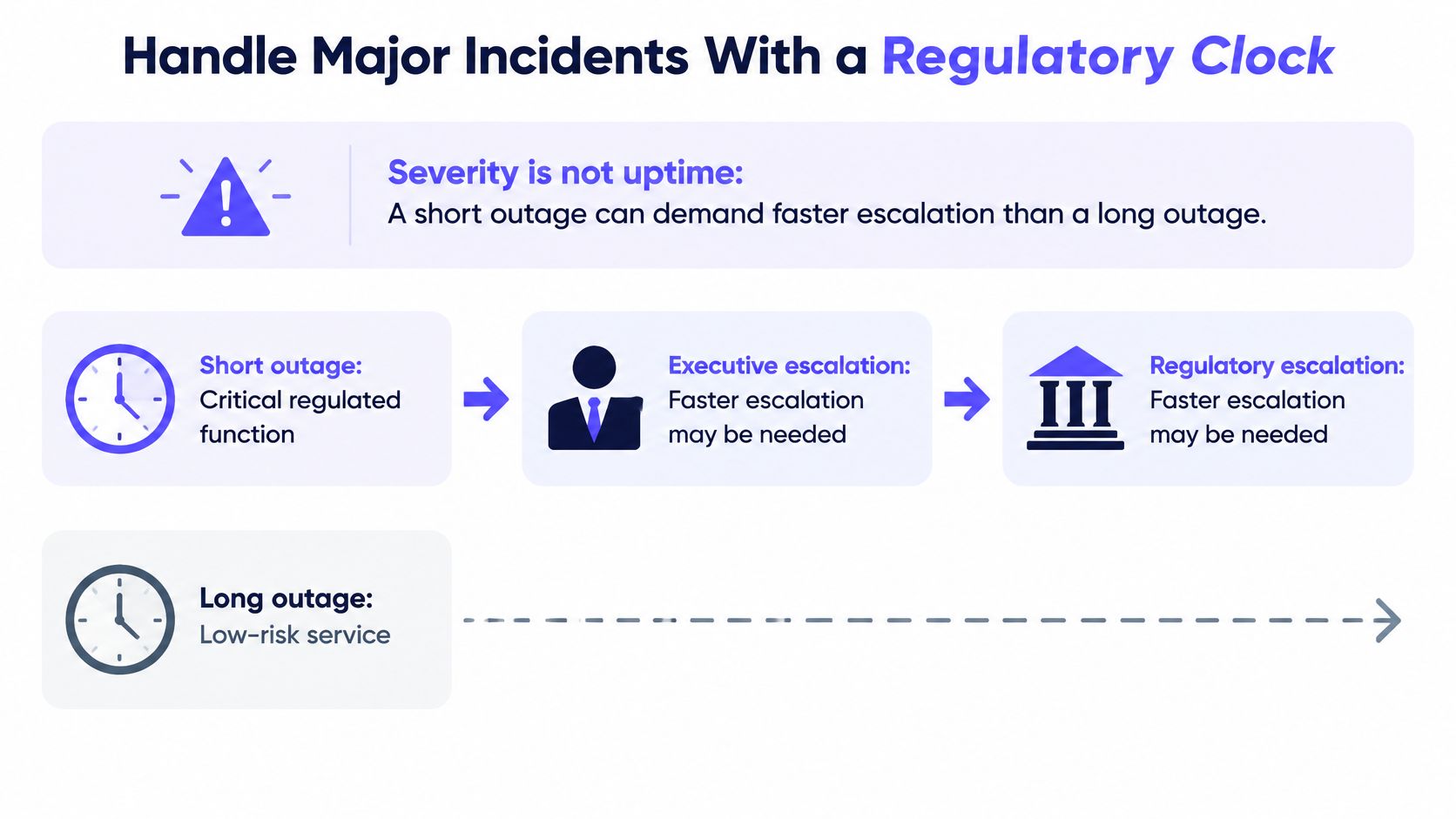
Function criticality should be visible during triage, ahead of duration.
Give classification an accountable owner
A mature assessment connects technical signals to affected customers, transaction volume, geographic spread, duration, data loss, service criticality, and economic impact. The regulatory owner determines the reporting position through the approved governance process, while the commander keeps coordinating recovery. Splitting these two decisions is what lets the reporting clock and the repair effort move at different speeds without colliding.
A payment-authorization outage illustrates the stakes. Blocked customer transactions can justify urgent assessment even if engineers restore service in twenty minutes. An internal reporting tool could stay down far longer without the same business impact. Neither conclusion should rest on the uptime dashboard alone.
Evidence preservation needs an explicit instruction. Responders should retain relevant logs and decision records before destructive remediation where feasible, with conflicts resolved through the agreed authority model.
Restoring service doesn't erase an awareness timestamp or finish a reporting obligation.
Early estimates should be labeled, preserved, and corrected as facts improve. Waiting for perfect certainty can leave the regulatory owner without enough time to assess and submit a report.
Pilot the Process on Your Next Real Incident
A bounded pilot is more useful than a policy rewrite applied across every service at once. A proposed month-long trial on a single service gives the team a manageable way to test the timer matrix, role assignments, and decision log under actual operating conditions.
The pilot should measure where response waits, not just when service returns. These are diagnostic warning signs rather than universal performance benchmarks.
Measure waiting separately from technical work
| Metric | How to calculate it | Warning sign |
|---|---|---|
| Acknowledgement latency | Median elapsed time from page to acknowledgement, segmented by severity | Repeated misses against the applicable acknowledgement deadline |
| Timer breach rate | Share of incidents missing any defined deadline | Recurring breaches without an identified corrective action |
| Time to named incident commander | Elapsed time from detection to a named commander in the log | Remediation decisions begin before anyone accepts command |
| Escalation count per incident | Escalation steps taken before resolution | A sustained rise that service impact doesn't explain |
| Time awaiting approval | Elapsed time waiting for remediation or communication decisions | Approval takes longer than the investigation |
| Duplicate handoffs | Task transfers between owners, including returns to previous owners | A repeated handoff without a logged reason |
| Repeat incidents by trigger | Recurrence grouped by trigger category | The same category recurs across successive postmortems without follow-up |
Counts alone won't explain a failure. An escalation to a database specialist may be exactly what the process intended, while an escalation caused by stale contact information is a configuration defect.
Similarly, a quick acknowledgement followed by a long approval wait points to a different problem than an unanswered page. Combining them into an overall recovery average makes the corrective action harder to identify.
Change the smallest thing that removes a delay
- Record ownership early. Capture the classification, active timers, and responsible people at incident declaration, then keep the record current.
- Review every missed deadline in the postmortem while participants can still explain what happened. Distinguish inaccessible tooling, unavailable staff, unclear authority, and insufficient technical context.
- Make a narrow adjustment. Change a timer, role boundary, or routing rule, then evaluate whether the next incident shows the intended behavior.
A small monitoring rollout can follow the same discipline: an uptime check, an escalation workflow, and a shared Slack or Microsoft Teams destination. Additional services and channels should follow once the team trusts acknowledgement handling and can explain every fallback.
Success means the next responder knows what to do, the next decision has an owner, and the reporting owner can identify the applicable deadline. More notifications aren't evidence of a healthier incident escalation process.
Fivenines offers infrastructure monitoring and workflow automation for routing, delays, retries, and escalations, with notifications to collaboration tools and other channels. Teams can visit Fivenines to start with a service check and a bounded escalation workflow, then test acknowledgement and fallback behavior against their policy.