How to Monitor Devices on Network in 2026

The usual advice to scan every subnet and monitor everything creates a busy dashboard, not dependable coverage. A discovered MAC address doesn't establish ownership, expose useful health counters, or justify waking an engineer. For MSPs and hosting teams, the better starting point is a short list of devices whose failure interrupts a contracted service.
Discovery is not monitoring. Useful coverage combines a device-specific signal, a trustworthy polling path, and a clear decision about who responds. Unknown gadgets can remain visible without becoming monitored production dependencies.
Table of Contents
- Which Check Fits Each Device
- How to Put Devices on a Monitor
- Inventory Gear You Cannot Install On
- When a Device Alert Should Page
- Tips for Many Clients and Regions
- Put Critical Devices on a Monitor This Week
Which Check Fits Each Device
| Device class | Primary signal | What it proves | What it misses |
|---|---|---|---|
| Router, core switch, firewall | SNMPv3 interface octets, errors, discards, CPU, memory, adjacency | Counter-derived errors and saturation, management reachability, routing state | User experience past the device |
| Access switch | SNMP interface octets, errors, discards, port state | Congested or erroring links and reported port state | Health of attached gear that doesn't expose telemetry |
| Server or appliance with a known port | TCP connect to the expected listener | Listener accepted a connection | Path quality, interface errors, and application correctness |
| Gateway or AP, no credentials | ICMP from independent regions where publicly reachable | Basic reachability from those vantage points | Application failure while ping works |
| Printer, camera, sensor | DHCP, ARP, or switch-port state; SNMP only with a stable MIB | Evidence that the device is present | Performance and configuration health |
| Unnamed or roaming gear | Presence only, never page | Something appeared on the network | Owner, health, and root cause |
Online isn't healthy. A firewall can answer ping while dropping customer traffic through a saturated interface, and a switch can remain reachable while an uplink accumulates errors. Conversely, an ICMP failure can reflect filtering rather than a failed device.
Choose the signal before the tool
The distinctions between network device classes matter because the useful measurement changes with the device's job. An access switch needs interface visibility. A service appliance needs a connection test to its expected listener, ideally supplemented by an application-level transaction when correctness matters.
A TCP connection to an HTTPS listener proves less than a successful HTTPS request. It establishes that the listener accepted a connection, not that authentication, backend dependencies, or response content worked. Management listeners such as SSH should remain private rather than being exposed merely to make an outside probe possible.
For infrastructure counters, start with interface octets, errors, discards, CPU, memory, environmental sensors, and routing adjacency where the device exposes them. Applications should control both the telemetry selected and its export frequency, and telemetry shouldn't include end-user packet content, according to the IETF network telemetry framework.
Validate meaning before increasing resolution
Keep initial interface history in five-minute aggregates and compare a collection window against CLI counters. Compare counter changes over matching periods, not a cumulative CLI total against a graph showing a rate. Check interface identity, speed, counter resets, and whether the monitored port carries production traffic.
Collection rule: More frequent wrong measurements produce a more detailed wrong graph.
Shorter intervals belong on signals that change quickly enough to justify them. Routing events may suit on-change telemetry; capacity trends usually don't require indiscriminate streaming. Filter subscriptions and avoid overlapping collectors walking the same objects.
Assign each owned device one primary row from the table. Supplemental checks can follow, but the initial signal must match observable reality before paging is enabled. Everything unclassified stays dark to health alerting, not invisible to inventory.
How to Put Devices on a Monitor
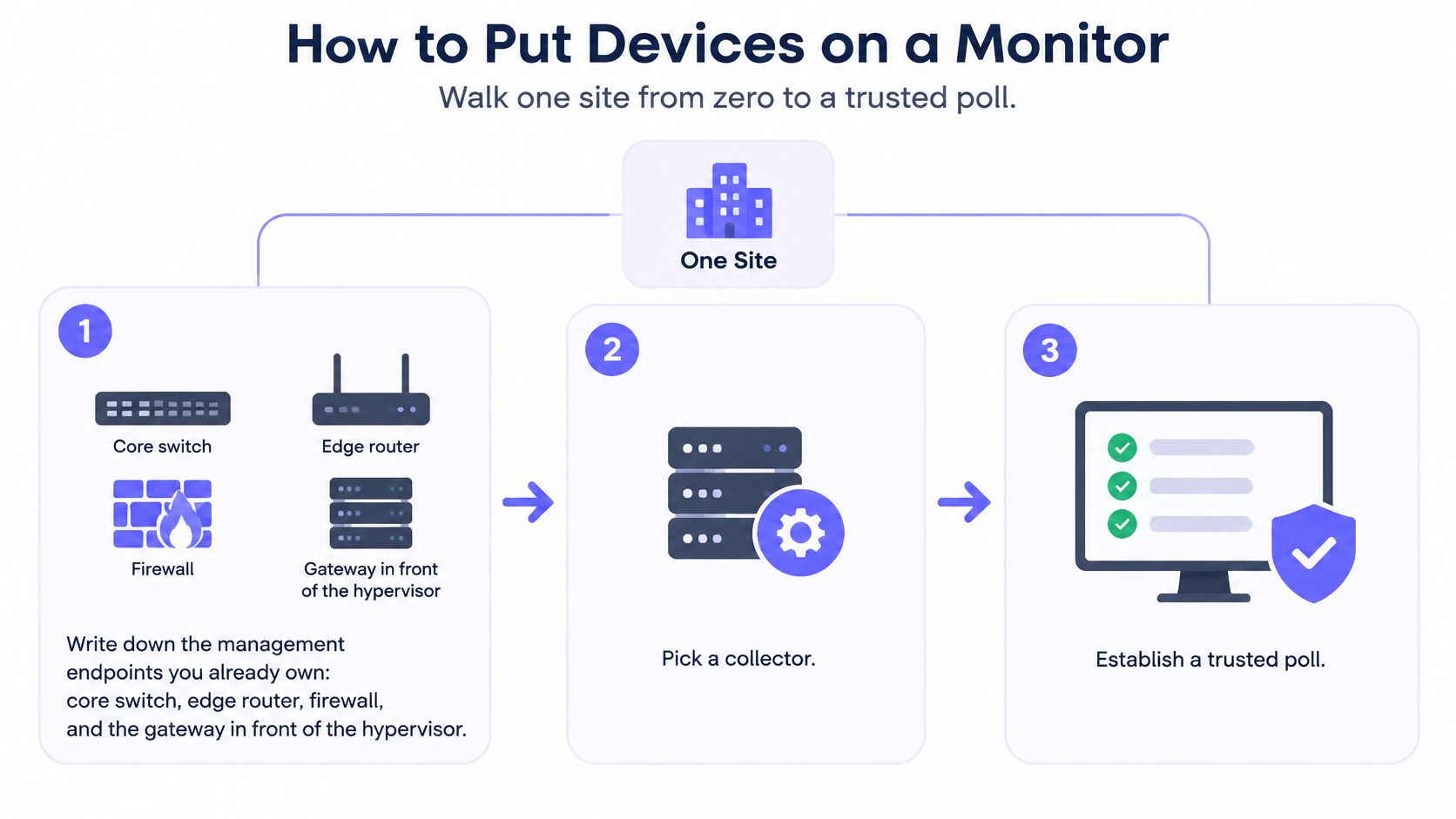
A trusted poll requires a known endpoint, a controlled management path, and a measurement that agrees with the device. The collector's location matters as much as the credentials.
The site workflow starts with explicit enrollment rather than a subnet sweep.
Establish the management path
Record owned management endpoints, including the core switch, edge router, firewall, and hypervisor gateway, because a production address and a management address may terminate on different paths. Record the expected interfaces and management VRF alongside each endpoint.
Choose an agent host inside the client network that can reach the devices' SNMP service, because polling from an administrator's laptop won't provide a persistent or representative path. Verify routing and access to UDP port 161 from that host, not merely from a jump server.
Enable SNMPv3 with authentication and privacy, using read-only access and restricted management sources, because monitoring credentials provide access to sensitive operational information. The IETF SNMP deployment guidance states that SNMPv2c provides no authentication, integrity, or confidentiality; an ACL restricts sources but doesn't replace transport protection such as IPsec when confidentiality is needed. Rotate credentials and investigate unexpected polling volume.
Enable polling and add each device explicitly with its address, SNMP settings, credentials, and collector assignment, because reachability from the selected agent host determines whether collection works. Select customer-facing interfaces rather than importing every unused port, tunnel, and internal object.
Prove that collection works
Poll the selected counters and compare a matching CLI sample, because a successful SNMP response doesn't establish correct interface mapping or rate calculation. Include routing adjacency where supported, and keep a note of unsupported objects instead of treating missing values as healthy zeros.
Attach an independent reachability or service check, because a stopped collector mustn't become an apparent site-wide device outage. Outside probes should target authorized, externally reachable addresses or services; private management addresses require an appropriate private vantage, not public exposure.
Assign the client, site, owner, and meaning of down, because the person responding needs to distinguish a failed management interface from a customer-facing outage. Keep the alert unarmed until that distinction is documented.
The accompanying video provides another view of the setup workflow.
- Investigate gaps from the collector's actual path, because a successful test from elsewhere doesn't clear its ACLs, MTU, routing, or resource limits. Use tcpdump or Wireshark with a narrow SNMP filter covering UDP ports 161 and 162, then compare request, response, and timeout patterns with device CPU and interface counters.
Capture complete SNMP frames when packet-level diagnosis is necessary, but keep the capture restricted to the management exchange. Anonymize sensitive fields, encrypt retained traces, and remove them under a defined retention policy. This diagnostic exception isn't permission to collect customer packet payloads.
Inventory Gear You Cannot Install On
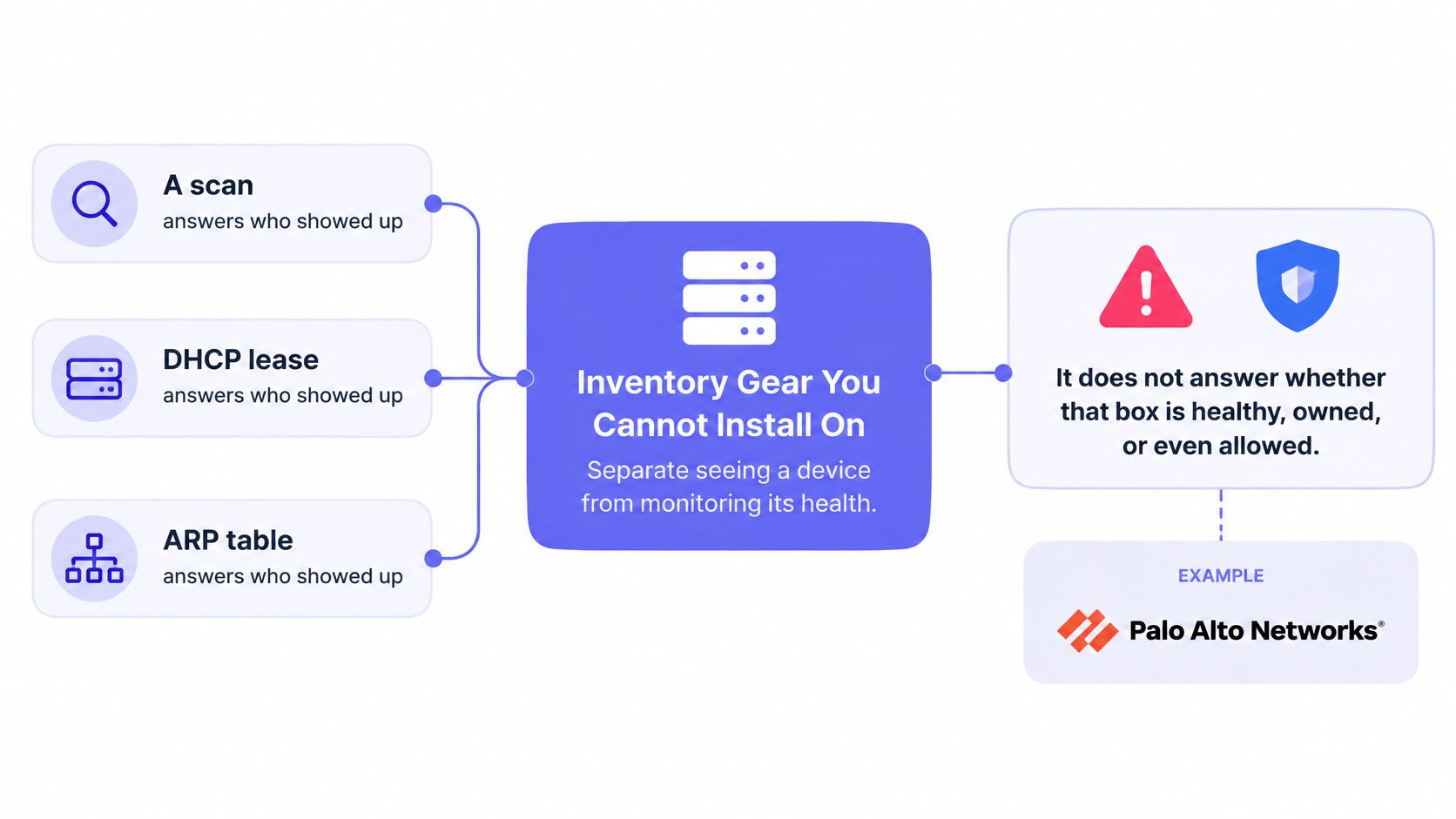
32.5% of devices operated outside organizational control in a Palo Alto Networks analysis of more than 27 million devices across 1,803 enterprise networks, including IoT and employee-owned equipment, according to its enterprise device security report. That finding concerns control, not merely agent installation. A device can be agentless yet fully owned, documented, and manageable.
ORDR separately reported that 42% of enterprise assets were agentless in its 2024 IoT and OT report, including operational technology, facilities assets, and specialized devices. Neither finding means that every new discovery should receive a poller or that all agentless equipment lacks health telemetry.
The useful distinction is between evidence of presence and evidence of health.
Reconcile sightings before assigning checks
Start with a site's DHCP leases, DNS names, switch MAC table, and gateway ARP table. Match timestamps, network segments, and switch ports before merging records. A DHCP lease may outlive a connection, an ARP entry may remain cached, and an uplink can represent many downstream devices.
A name isn't ownership evidence by itself. Vendor identification can help classify a camera or printer, but it doesn't establish which department approved it or who maintains it.
| Inventory bucket | Permitted starting signal | Requirement for stronger monitoring |
|---|---|---|
| Owned infrastructure | Managed health counters and service checks | Confirmed owner, supported telemetry, known production role |
| Facilities and specialized gear | Presence, port association, approved gateway or flow metadata | Stable interface, vendor support, operational reason for added collection |
| Unknown, personal, or guest equipment | Time-stamped sightings and classification | Ownership and authorization review before health enrollment |
Owned routers and switches can move directly into managed monitoring once credentials and scope are approved. Cameras, badge readers, printers, and sensors often need a more conservative approach. A supported SNMP interface can be useful, but a brittle vendor MIB that changes after firmware updates creates maintenance work without dependable coverage.
Understanding SNMP and MIB behavior helps separate a protocol response from a useful, stable measurement. Presence may be enough for a temporary loaner; a production camera supporting a contractual security service may justify a dedicated availability check.
Keep lifecycle decisions separate from discovery
Retained inventory entries need a client, site, accountable owner, expected network location, and retirement or review date. Personal phones and guest laptops generally need an access-policy record, not a performance graph or an on-call destination.
A device without a monitoring owner can still be a security concern. Removing its health check mustn't erase the evidence needed to investigate it.
After the review window, remove unowned sightings from the maintained health inventory or demote them to expiring discovery records. Suspected unauthorized equipment should remain in the security workflow until resolved. Deleting the graph isn't remediation.
Risk-based coverage asks whether the team can detect meaningful disappearance, unusual communication, or unapproved exposure. It doesn't require full counters for every MAC address, especially when the address represents roaming equipment rather than a stable service dependency.
When a Device Alert Should Page
A 2025 survey cited by SDxCentral's observability coverage found that 87% of network teams used multiple observability tools, while 15.7% identified alert fatigue as their biggest complaint. Adding another notification destination doesn't resolve unclear ownership or weak confirmation.
The routing decision should depend on corroborated service impact and dependency state, not just the device's importance label. The following rules are a starting operating policy, with explicit exceptions for services whose failure cannot tolerate a confirmation delay.
| Symptom | Send it to | Rule |
|---|---|---|
| ICMP or TCP fails from independent regions, parent uplink up | Page | Confirm from another vantage before waking an engineer |
| SNMP unreachable and the service check fails | Page | Require corroborating signals, not an isolated poll timeout |
| Interface errors or discards high, device still up | Ticket | Investigate degraded capacity during staffed hours unless service impact is urgent |
| Single probe fails, others pass, then it recovers | Note | An isolated vantage failure isn't a confirmed device outage |
| Device inside a maintenance window | Note | Silence notifications for the window without deleting the check |
| Flap shorter than the configured confirmation period | Note | Retain the event and wait for persistent failure |
| Child down because the parent uplink is down | Suppress | Route the cause as an incident rather than duplicating downstream symptoms |
Confirm independence, not just quantity
Two checks aren't necessarily independent. SNMP and TCP launched from the same collector can fail together because that host lost its route. Outside probes sharing the same transit problem can also agree for the wrong reason.
For a page-worthy device failure, the parent path should remain healthy and the confirming checks should test meaningfully different failure domains. If the parent is also down, route the incident to that dependency. Keep child symptoms attached as evidence without opening separate response work.
Paging test: The notification should identify an action that an accountable responder can take now.
Errors and discards usually belong in tickets when reachability and customer service remain intact. Rapid deterioration with confirmed user impact is different. A rigid rule that all capacity faults wait until morning can be as damaging as paging on every counter increment.
Make escalation predictable
An incident escalation process should specify the initial owner, acknowledgment deadline, backup responder, and recovery destination. Apply a short confirmation delay appropriate to the service, rate-limit repeats on the same object, and send recovery to the original incident channel.
Maintenance windows should expire automatically. Suppressed children should remain visible, with the suppression reason attached, so a faulty dependency map doesn't hide an unrelated failure indefinitely.
The page itself needs the device role, client, site, failed signals, parent status, last successful observation, and runbook. A responder shouldn't have to reconcile several dashboards before deciding whether the alert describes a failed router or a failed polling path.
Tips for Many Clients and Regions
Across a client portfolio, the hard problem isn't repeating device enrollment. It's preserving tenant boundaries, collection health, and response ownership when several sites fail at once. A shared console helps only when operators can still identify whose service is affected and which observation path remains trustworthy.
The operating model should scale without multiplying overlapping collection jobs.
Separate tenants without duplicating operations
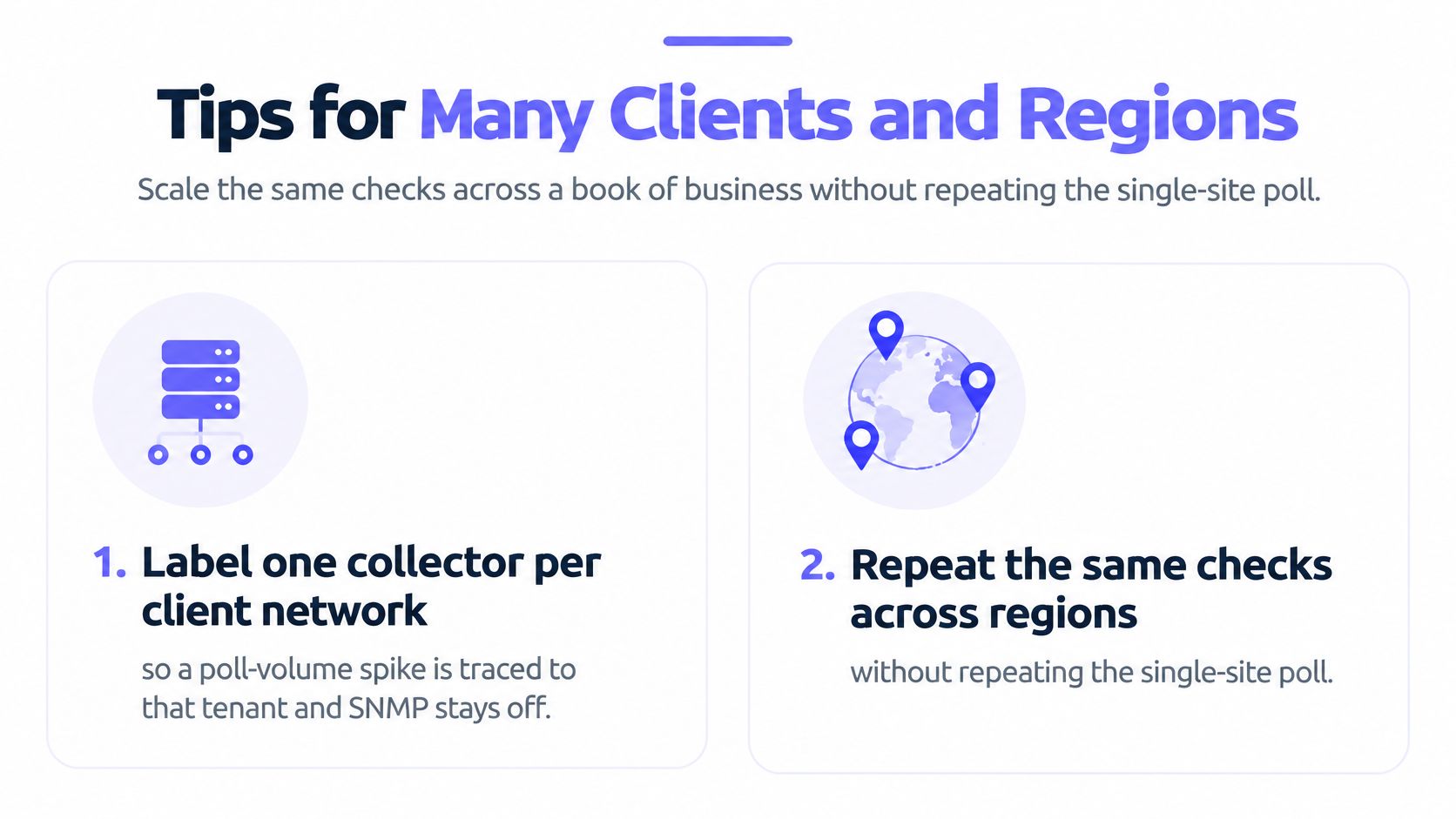
- Label collectors by client network. Attribute polling load, credential failures, and missing data to the correct tenant. Overlapping private address spaces make collector identity part of the device's identity, not optional metadata.
- Separate response streams. Client-specific status pages, alert routing, and on-call ownership prevent a noisy firewall at one customer from obscuring another customer's failed border router.
- Standardize templates, preserve exceptions. Reuse naming, counter selection, and notification policy, but retain device-specific exclusions and contractual response requirements. A template shouldn't overwrite a deliberate exception.
- Assign collection ownership. Nominate the system responsible for each counter set. Duplicate MIB walks add device work and create conflicting histories without supplying an independent vantage.
The Nutmeg Technologies monitoring guide offers a broader resource for teams reviewing network-monitoring practice. For MSP operations, that review should lead to a concrete responsibility map rather than another tool collecting the same signals.
Treat collection as a production service
Chart collector CPU, poll duration, timeout rate, queue age, and free disk. Alert on collector failure through an independent route, and label affected device state as unknown or stale, not down. A saturated poller can otherwise generate a convincing but false client-wide outage.
Centralized monitoring should unify decisions without forcing every management packet through a shared failure point. Where the design permits, separate management traffic from production traffic and retain regional perspectives on externally reachable services.
When a collector site loses transit but outside service checks remain healthy, operators should investigate the observation path first. Historical graphs should preserve missing intervals rather than drawing an uninterrupted healthy line through them.
- Retain meaningful history. Keep enough detail to compare recurring business patterns, and reserve faster collection for named links with a demonstrated need.
- Keep administration in the RMM. Patching and remote shells do not need to migrate just because health monitoring changes.
- Review ownership regularly. Remove paging rights from abandoned objects, demote unnecessary checks, and confirm that each client's escalation contact still exists.
The failure to avoid is a second platform nobody operates. Clear boundaries between monitoring, administration, and incident response reduce that risk more effectively than a larger dashboard.
Put Critical Devices on a Monitor This Week
A useful initial deployment fits into an afternoon because the scope follows service dependencies rather than subnet size. For example, an MSP could select about ten objects whose failure would interrupt a client's production service: the edge firewall, core switch, border router, hypervisor gateway, DNS service, and the uplinks carrying customer traffic.
That example is a planning limit, not a coverage score. A redundant pair may deserve separate device checks and a shared service test, while an idle spare may need only inventory and configuration control.
Build an acceptance list
- Select by consequence. Each object needs a sentence explaining which customer service fails when it fails. Equipment with no clear consequence doesn't belong in the initial paging scope.
- Enroll deliberately. Add management addresses explicitly and select relevant interfaces. Avoid treating a successful scan as completed implementation.
- Validate the evidence. Match collected values with device output, verify interface descriptions, and document what a passing check proves.
- Exercise the notification path. Use an approved maintenance test to confirm routing, acknowledgment, suppression, and recovery behavior before relying on the check overnight.
The completion test isn't a green dashboard. An operator should be able to distinguish device failure, collector failure, lost transit, and an intentionally disabled listener without guessing.
Stop at a dependable operating boundary
Cameras, printers, and unidentified sightings can remain on reviewed presence lists while the critical set is commissioned. Client grouping should match contractual responsibility, so the status view and notification stream describe the same operational boundary.
Fivenines is a fit for this deliberately selected list: network devices are added explicitly for SNMP v2c/v3 polling of interface traffic, errors, and reachability alongside server metrics; HTTPS, TCP, ICMP, and DNS uptime checks run from four probe regions. Its monitoring can run alongside an existing RMM that retains endpoint administration, patch deployment, and remote access.
Device-specific support still needs validation. A platform's ability to poll SNMP doesn't guarantee that every vendor exposes routing adjacency, environmental sensors, or the same counter names. Unsupported measurements need a documented fallback, not a green placeholder.
Stop expanding coverage when the team can no longer explain who owns a check, what failure means, or why its alert deserves attention.
The initial set is complete when every critical object has an owner, a trusted observation path, an appropriate confirming vantage, and an actionable routing rule. Additional objects should enter through the same acceptance process. A smaller monitored fleet with defensible alerts is more useful than an extensive-looking inventory that operators routinely mute.
Fivenines combines SNMP device health, server metrics, uptime checks, and cron monitoring in one place. Visit Fivenines to put a deliberately chosen set of critical devices under monitoring, pair their health signals with outside checks, and organize the response by client.