Proxmox Cluster Quorum Monitoring: What Alerts Should Mean

The most repeated advice about Proxmox quorum problems is a command. Force the cluster quorate, drop the expected vote count, get the management interface writing again. That advice treats a safety mechanism as a nuisance, and it's the wrong first move for anyone holding a pager. A quorum alert doesn't say a host is dead. It says the cluster may no longer be permitted to change distributed state, and it says nothing about whether the reading behind the alert is current.
Good Proxmox cluster quorum monitoring starts by splitting that one alert into the signals it's made of, then classifying what's broken before anyone touches the cluster. Three outcomes look identical on a naive dashboard: a node stopped answering, the monitoring path stopped collecting, and the voting majority disappeared. Only one of those is a cluster incident.
Table of Contents
- Votes, Membership and Quorum Are Different Signals
- How to Run the Read-Only Quorum Checklist
- Lost Collection Is Not Confirmed Quorum Loss
- Two-Node Clusters and the QDevice Vote
- Escalation Decision Tree for Quorum Alerts
- Capacity After Quorum Recovers
- Confirm One Node and One Alert Before You Rely on Them
Votes, Membership and Quorum Are Different Signals
A quorum alert means the cluster may refuse state changes. It doesn't prove a node is down, and it doesn't prove the reading is fresh. Treat it as a question about permission, not a question about uptime.
Quorum is a voting rule, not a heartbeat. The Proxmox VE cluster manager chapter documents one vote per node by default, quorum as a majority of the configured votes (so a three-node cluster normally needs two reachable votes, stays quorate after losing one node and blocks normal cluster operations after losing two), corosync traffic on UDP ports 5405 to 5412, and recommended inter-node latency below 5 ms for stable operation.
Why the majority rule exists
The rule stops two isolated network partitions from changing cluster state independently. Without it, each side could rewrite the same guest configuration or make conflicting HA decisions, and the cluster would have no way to decide which version wins. Blocking writes is the intended behaviour, not a bug to route around.
That's also why a transient corosync fault and a failed host can produce the same immediate symptom. Both remove votes from the count. The difference lives in the surrounding evidence: which node reported the transition, when, and what the links were doing at the time.
What each signal proves on its own
| Signal | Question it answers | Healthy reading | What it does not prove |
|---|---|---|---|
| Node reachability | Does this host answer its peers? | Host responds from more than one peer | That its vote is counted |
| Votes | How many votes are counted? | Total votes at or above Quorum, a majority of Expected votes | That guests on the voting nodes are running |
| Membership | Which nodes are in the cluster view? | Every expected node listed on every node queried | That each corosync link is redundant |
| Quorate | May the cluster change state? | Quorate: Yes on the node queried | That guests, storage or backups are healthy |
| Corosync links | Is cluster traffic flowing? | Every configured link up on each node | That quorum holds under load or after another node loss |
| QDevice vote | Is the external tie-breaker contributing? | QDevice reachable and its vote in Expected and Total votes | That the QDevice sits outside the cluster failure domain |
Read the last column as the alert design. Every signal has a blind spot, and an alert built on one signal inherits it. A node-down alert and a loss of voting majority are different conditions with different owners, different urgency and different recovery paths.
How to Run the Read-Only Quorum Checklist
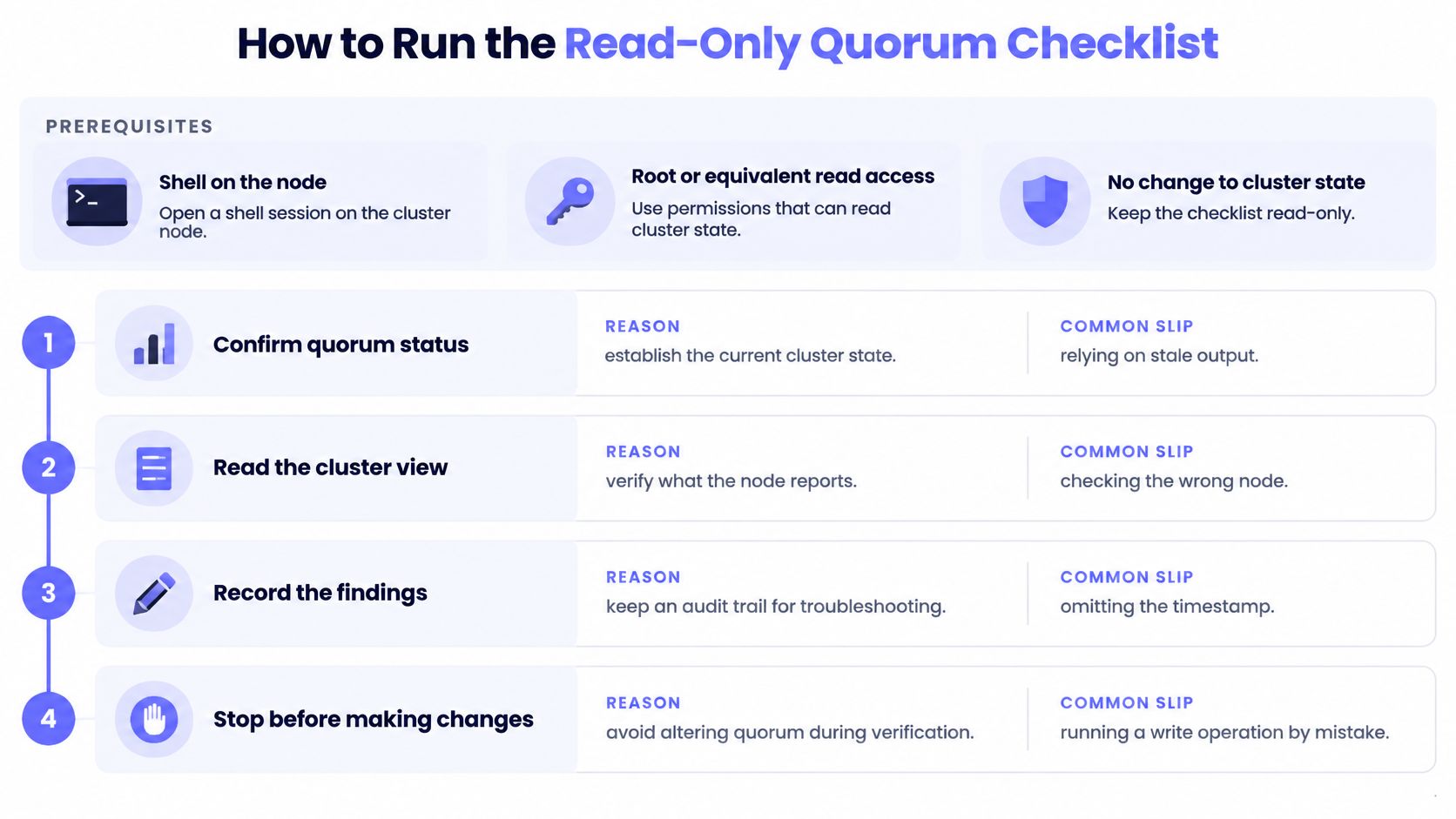
Prerequisites are small: a shell on the node, root or equivalent read access, and a firm rule that nothing in the sequence changes cluster state. Every command below reads. None of them votes.
The sequence
- Pin the version first. Run
pveversion -v. Field names inpvecm statusdiffer between releases, so this decides which manual page the readings should be compared against. - Record identity and time.
hostnameanddate -u. A reading without a node name and a UTC timestamp isn't evidence, it's a rumour. - Read the vote state.
pvecm status. Note Quorate, Expected votes, Total votes and Quorum as four separate values, not as one green light. - Read membership.
pvecm nodes. Compare the listed members against the expected inventory. A missing name is a membership gap, not proof of a failed host. - Read link state.
corosync-cfgtool -s. This reports the links on the node being queried, so it answers a local question only. - Read the corosync quorum view.
corosync-quorumtool -s. Useful whenpvecmand the underlying membership layer disagree. - Repeat steps 3 to 6 on a second node. One node's view is one opinion. Two matching views are a finding.
Practical rule: record the exit code of every command. A timeout, a non-zero exit or empty output is a collection failure, not a quorum reading.
Two checks that catch the transient case
systemctl status corosync shows whether the daemon restarted recently, and journalctl -u corosync --since "-15min" shows link loss and rejoin events in the window that matters. A cluster that lost quorum for a few seconds and recovered leaves its trace here, while pvecm status looks perfectly clean afterwards.
Illustrative output
The following is an illustrative example, not a captured session. Exact formatting depends on the installed Proxmox VE version, so check field names against the manual for the version reported by pveversion -v.
Quorum informationQuorate: YesVotequorum informationExpected votes: 3Total votes: 3Quorum: 2
A healthy three-node cluster shows matching membership on every node queried, identical total votes across those views, and every configured link up. Anything else is a difference worth writing down before it's explained away.
Lost Collection Is Not Confirmed Quorum Loss
Three states cover almost every quorum-shaped alert, and they're not variations of the same problem.
Node offline means one member stopped responding while the remaining members still hold a majority. The cluster is degraded and still permitted to change state. Reporter offline means the monitoring path lost its data. The cluster might be perfectly healthy, perfectly broken, or anywhere between, and the dashboard can't tell which. Confirmed quorum loss means live, verifiable nodes hold fewer than a majority of votes, and the views were fresh when taken.
Test order matters more than the threshold
Check collection freshness first. Only then ask whether a second live source agrees. Reversing that order is how a monitoring outage gets escalated as a cluster outage, and how a real partition gets dismissed as "probably the agent again".
An illustrative freshness rule, to be tuned per environment: treat a reading older than two collection intervals as unknown. Any alert sourced from an unknown reading routes to the reporter path, not to the on-call cluster owner. That single routing rule removes most of the noise a generic node-down check produces.
| Observation | Node offline | Reporter offline | Confirmed quorum loss |
|---|---|---|---|
| Collection freshness | Current for other nodes | Stale or missing for all nodes | Current from at least two live views |
| Peer votes | Peers still report votes | Unknown, no fresh data | Live votes below majority |
| Quorate flag | Yes | Unknown, not healthy | No, on two consistent views |
| Membership | One node missing | Data missing | Majority of expected nodes absent |
| Next action | Verify node and network path | Verify reporter path and credentials | Escalate using the decision tree |
Unknown is never healthy. A missing reading must render as unknown, never as quorate, and never as a green tile that happens to be left over from the last successful poll. Stale-green is the most expensive display bug in cluster monitoring, because it silences the exact incident the monitor exists to catch.
Keep the node identity and timestamp attached to every transition. A brief corosync communication fault and a dead hypervisor produce the same quorum symptom, and the only way to tell them apart afterwards is the sequence of events with times attached. Where the network path itself is suspect, the techniques in packet loss detection help separate a lossy inter-node link from a host that's genuinely gone.
Two-Node Clusters and the QDevice Vote
Two nodes can split so each side holds one vote and neither holds a majority. It's a tie with no referee, and both halves correctly refuse to act. That's the even-node problem, and it's why the Proxmox cluster manager documentation recommends a QDevice for higher availability in even-node clusters, with the external vote daemon running on an independent server.
A QDevice adds an externally decided vote. It doesn't add a hypervisor, storage, or any capacity at all.
What to monitor about the external vote
- Reachability as its own signal. The vote daemon is a separate dependency with its own failure modes, not another cluster node.
- Its contribution to the count. Confirm the QDevice vote appears in both expected and total votes, rather than assuming it's there because it was configured once.
- Its failure domain. Ask whether the QDevice shares power, network or rack with a cluster node. If it does, one failure can remove two votes at once.
Consider an illustrative design, not a deployed one: a two-node cluster whose QDevice runs as a VM on one of its own hypervisors. That host now carries two votes. Losing it takes out the node and the tie-breaker together, which is exactly the outcome the external vote was supposed to prevent. The configuration passes every syntax check and still fails the only test that matters.
What the alert should say
A useful QDevice alert carries enough context to classify itself. For each counted vote, state whether it comes from a node or the QDevice. Name the QDevice host. State whether quorum still holds without that vote.
With those fields, the routing writes itself. QDevice unreachable while the cluster stays quorate is a degraded-resilience warning: the next failure will hurt more than it should, but nothing is blocked right now. QDevice unreachable with quorum gone is an outage. Same daemon, same symptom, two different priorities.
Setup requirements, daemon placement rules and supported configurations belong to the current Proxmox documentation, and they change between releases. Alert design is the part that stays stable, and it's the part most guides skip in favour of recovery commands.
Escalation Decision Tree for Quorum Alerts
The tree below assumes the read-only checklist has already run and its output is attached. Each branch ends in an owner and a recovery rule, not in a command that changes cluster state.
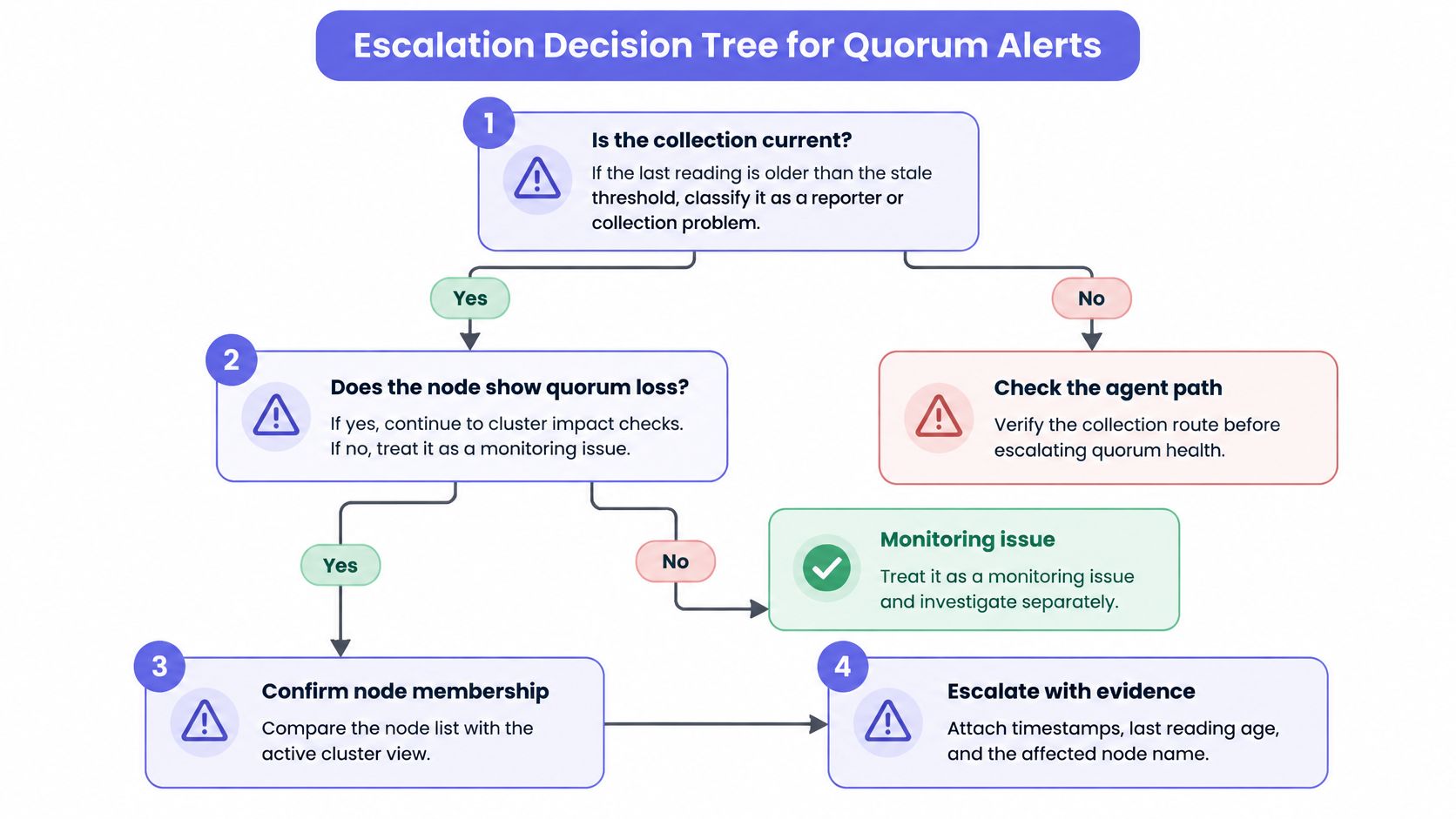
- Is the collection current? If the last reading is older than the stale threshold, classify it as a reporter or collection problem. Check the agent path, the API credentials and the reporter host, then stop. This branch never becomes a quorum incident on its own.
- Do two live views agree? Compare votes and membership from a second node. If they disagree, record both views verbatim and collect again rather than picking the one that looks worse. Disagreement between fresh views is itself a finding, usually pointing at the inter-node network.
- Is one node unreachable while total votes still meet the majority? Classify it as a node offline event. Open a ticket against that host and watch a sustained window before paging anyone. Ten minutes is an illustrative starting point, not a universal value; a cluster running dense HA workloads may justify a much shorter one.
- Is Quorate No confirmed from two live views? Classify it as confirmed quorum loss and escalate immediately. Hand over the timestamp, the membership list and per-node link status with the page, so the responder starts with evidence instead of re-running the checklist.
- Has quorum returned? Require a run of consecutive good readings before clearing the alert, then move to capacity checks rather than closing the incident. Flapping quorum that clears on the first good poll hides the underlying fault.
Monitoring never runs
pvecm expectedor any forced-quorum command. Those are recovery decisions for the cluster owner under change control, taken with the partition understood and the risk accepted in writing.
The QDevice branch
QDevice unreachable while the remaining votes still hold quorum is degraded voting resilience. Route it to the infrastructure owner with a maintenance window and no page. QDevice loss that also removes quorum is confirmed quorum loss and follows branch four. The distinction is only available if the alert carries the vote breakdown described earlier.
What the handoff must contain
Write the escalation payload once and reuse it: UTC timestamp, node and QDevice names, expected, total and quorum votes from two live views, per-node link state, and the time of the last corosync restart. Anything missing forces the responder to re-collect under pressure.
Roles, response timing and who owns which branch belong in a written process, not in tribal memory. The incident escalation process covers that structure, and the routing and notification side is handled in how to set up alerts.
Capacity After Quorum Recovers
Quorum proves the cluster may change state safely. It doesn't prove there's spare capacity to run what it recovers.
That distinction gets skipped constantly, because "quorate" is a single boolean and booleans make satisfying dashboards. The Proxmox VE administration guide warns that HA requires at least three nodes for reliable quorum and that recovering HA services onto a single remaining node can overload it. Permission to recover and ability to recover are separate properties.
| State | Quorate | Typical vote condition | What to check next |
|---|---|---|---|
| Healthy quorum | Yes | Total votes at or above quorum, all expected nodes present | Node saturation and backup freshness |
| Quorum held, capacity degraded | Yes | Majority present after a node loss | CPU and memory headroom, storage reachable from survivors, HA placement |
| Quorum lost | No, state changes blocked | Verified live votes below a majority of Expected votes | Escalate per the decision tree, no forced quorum or vote changes |
| Quorum restored, workloads under-recovered | Yes | Majority regained | HA resources started, guests serving, backups fresh |
An illustrative failure that looks like success
Take a hypothetical three-node cluster where each node runs close to its memory limit during normal operation. One node fails. The two survivors stay quorate, the dashboard goes green, and HA begins placing the displaced guests. Part of them start. The rest don't, because the memory isn't there. The quorum monitor reports nothing wrong, and it's right: quorum is fine. The service is down anyway.
Checks that connect votes to surviving hardware
- Headroom per surviving node. CPU and memory, measured against the load those nodes would carry after recovery, not against their current load.
- Storage reachability from the survivors. A pool that only the failed node could reach is a recovery blocker regardless of the vote count.
- HA placement and recovery activity. Which resources are placed where, and which are still trying to start.
- Whether started guests serve. A running guest is a hypervisor fact, not an application fact.
Post-recovery closure should require four things: quorate held for the full observation window, HA resources placed as intended, saturation below the agreed threshold, and backups fresh. Backup freshness deserves its own check rather than an assumption, and Proxmox backup monitoring covers how to verify it per guest. Adding a QDevice improves voting resilience and does nothing for any of these capacity questions.
Confirm One Node and One Alert Before You Rely on Them
A monitor that hasn't been compared against the node's own shell is an unverified opinion. The pilot is small on purpose: one cluster, one reporter, one test notification, no cluster changes.
Fivenines monitors whole Proxmox clusters from one agent, covering quorum, nodes, VMs, LXC containers and storage pools, with cluster quorum, node availability, guest state, storage pools and per-guest backup freshness in scope and one incident raised per real problem instead of one per node that noticed it. The reporter is one per cluster with optional redundant reporters, so the pilot unit is a single reporter, not an agent on every node.
The pilot, in order
- Pick a non-critical node and install the agent following the Proxmox monitoring guide, using a read-only API token.
- Verify three readings against the shell on that same node. The quorate state against
pvecm status, the membership list againstpvecm nodes, and the collection freshness against the reading timestamp. - Treat any mismatch as a finding. If the dashboard's quorate value disagrees with the shell output on the same node at the same time, investigate that before trusting a single alert. A monitor that's wrong about the easy reading will be wrong about the hard one.
- Confirm the quorum-lost trigger is enabled, then send a safe non-quorum test alert through the same notification route and confirm it reaches the intended person. Inducing real quorum loss is not a test, it's an outage with a plan.
- Repeat on another cluster only after the first readings match. Scaling an unverified configuration multiplies the same mistake across the fleet.
Boundary worth stating plainly: no state-changing command belongs in a monitoring pilot.
pvecm expected,pvecm addand node removal are cluster-owner decisions under change control.
Current capabilities, trigger names and plan-dependent limits should be checked on the Proxmox monitoring feature page before rollout rather than assumed from any article, including this one. The verification step that matters is step two: shell output and dashboard agreeing, on the same node, at the same timestamp.
Fivenines brings Proxmox cluster quorum, node availability, guest state, storage pools and per-guest backup freshness into one hosted view, alongside server, network, uptime and scheduled-job monitoring, so a quorum event arrives with context instead of as a bare boolean. Start with one cluster and one reporter, compare the quorate reading against pvecm status on that node, and test one safe notification before widening the rollout. Visit Fivenines to set up that first cluster check.