MSP NOC Services: Ownership, Handoffs and Escalation

The alert reached the overnight queue, but the client's application is still unavailable and nobody can name the engineer working on it. MSP NOC services need an explicit ownership contract, not just continuous monitoring: who validates the signal, who accepts the work, who can authorize a change, and who updates the client.
Table of Contents
- Why MSP Handoffs Fail Even When Monitoring Works
- Which NOC Model Fits the Client Contract
- Who Owns Each Step Between the Alert and the Client
- Severity, Owner and Acknowledgment Matrix
- Delivery, Acknowledgment and Escalation Are Different Events
- Copy-Ready Shift Handoff Template
- A Hypothetical Incident Split Into Observations and Hypotheses
- What an MSP NOC SLA Can and Cannot Promise
Why MSP Handoffs Fail Even When Monitoring Works
An MSP NOC service turns a detected condition into a named action for a client. The monitoring system detects the condition, a NOC operator validates it, an MSP engineer owns recovery, and a designated communicator tells the client what's happening.
Consider a hypothetical overnight application outage. The monitoring check fails correctly, but the notification goes to an unattended mailbox. Nothing happens because nobody owns checking that mailbox.
Another failure is less obvious: the NOC operator and MSP engineer both receive the alert, and each assumes the other has accepted it. Alternatively, an engineer acknowledges the page but gets pulled into another incident before starting diagnosis. The queue looks attended, yet recovery hasn't begun.
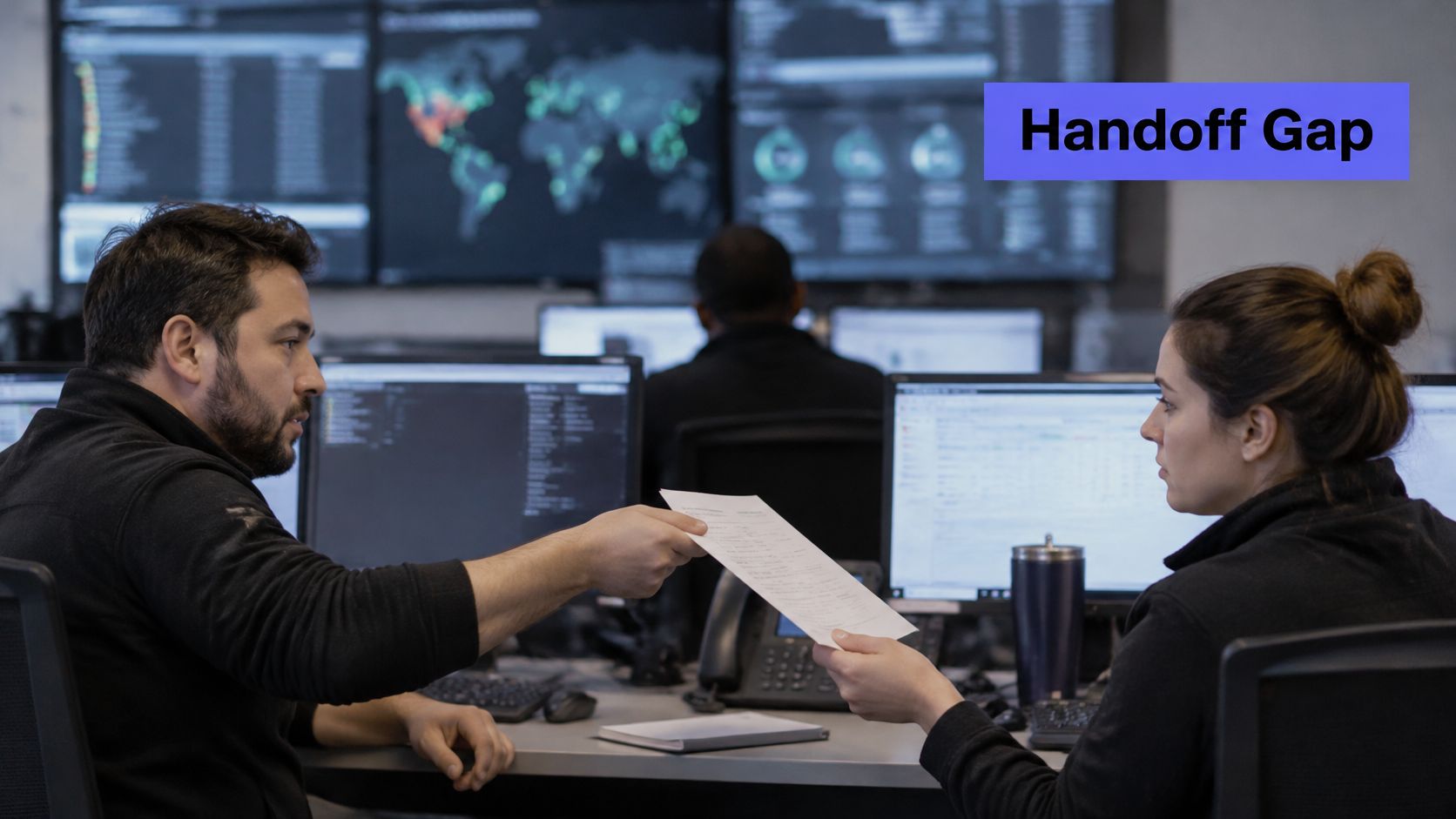
The handoff is an exchange of responsibility, not merely information.
Use terms that describe actual work
- Alert: A detected condition requiring evaluation.
- Acknowledgment: A named person's recorded acceptance of responsibility.
- Escalation: Engagement of the next designated responder when an agreed trigger is met.
- Handoff note: The evidence, actions, outstanding questions, and next task transferred with ownership.
- Client update: A statement of known impact, current action, and the next communication time.
The final break point is communication. An engineer may be diagnosing correctly while the client learns about the outage from reception staff, then calls an account manager who has no incident context.
Extra notifications won't fix these gaps. They can create more recipients without creating accountability.
Operating rule: Every open alert has exactly one named owner at every moment. The outgoing owner remains responsible until the incoming owner explicitly accepts the handoff.
Which NOC Model Fits the Client Contract
The operating model determines who answers an overnight alert. A coverage promise should name the actual staffing arrangement rather than leave the client to infer it.
| Model | First responder and escalation | Access and coverage | Main trade-off |
|---|---|---|---|
| In-house staffed NOC | Employee operator validates and engages the MSP engineer | Role-scoped access during rostered shifts | Direct control over training and runbooks, with fixed staffing obligations |
| Outsourced NOC | Third-party operator follows the MSP's runbook and escalation list | Contracted access and explicitly purchased coverage | Less internal shift management, but stricter scope and handoff requirements |
| On-call rotation without a NOC | Engineer receives pages directly and engages a backup | Engineer access during agreed on-call periods | Less organizational overhead, but alert volume interrupts the people doing recovery |
An internal NOC offers control, but it still needs holiday coverage, shift overlap, and a fallback for absence. An outsourced NOC needs a written boundary between read-only triage and authorized remediation. An on-call rotation can suit a smaller operation, provided the contract doesn't imply that operators continuously watch a queue.
Confirm the staffing boundary
Before signing, the service owner should record:
- First notification: The receiving queue or person, including the fallback.
- Escalation authority: The role permitted to engage another engineer or supplier.
- Access: The systems each operator can inspect and the changes each can authorize.
- Coverage: Staffed hours, on-call hours, time zone, and holiday arrangements.
When the choice involves adding personnel rather than purchasing an operated service, nexus IT group's IT staff augmentation vendor checklist offers a useful starting point for evaluating that staffing relationship. The MSP must still define its operational responsibilities.
Fivenines is monitoring software, not a staffed NOC service. Its readings and notifications support whichever staffing model the MSP chooses; they don't supply the person who accepts the incident.
Who Owns Each Step Between the Alert and the Client
Responsibilities matrix for one alert
| Activity | MSP engineer | NOC operator | Client contact | Monitoring platform |
|---|---|---|---|---|
| Raise alert | Sets client thresholds | Watches the alert queue | Not involved | Evaluates configured checks and sends notifications |
| Validate alert | Confirms client scope | Checks host state and recent changes | Not involved | Shows available readings and history |
| Assign severity | Approves client-specific severity | Applies the severity matrix | Not involved | Supplies configured labels where supported; otherwise use the ticket |
| Acknowledge | Owns follow-up work | Records acknowledgment time | Not involved | Supplies available delivery evidence; record human ownership in the incident log |
| Remediate | Owns fix and rollback | Supports read-only diagnosis | Approves change window | Not involved |
| Notify client | Approves wording | Sends update on cadence | Receives update | Not involved |
| Close and review | Owns root-cause investigation | Keeps evidence and timeline | Confirms closure | Supplies available readings and history for review |
This matrix assumes the MSP engineer owns remediation and the NOC provides triage. A contract authorizing NOC remediation needs explicit change permissions, validation steps, and rollback responsibilities rather than an informal extension of the operator's role.
The operator validates client scope and impact before involving the client contact. The engineer authorizes technical work, while the client contact approves business-facing change windows. Client approval doesn't transfer responsibility for a safe technical procedure.
Keep administration separate from monitoring
Fivenines can run alongside an existing RMM: the RMM handles endpoint administration, patch deployment, and remote access, while Fivenines handles server, service, SNMP, uptime, and cron monitoring. Its native PagerDuty integration is available on the Business plan and above; notification capabilities must match the selected plan.
The remote infrastructure monitoring guide covers the monitoring prerequisite. For incident work, the runbook should identify the actual administration tool and approved access method.
Configuration and change-management errors were the leading cause of networking incidents in Uptime Institute's 2025 outage analysis. Add named owners for pre-change review and post-change validation to the remediation procedure.
Copy the matrix into the client runbook and fill every role before go-live. A team name alone isn't an incident owner.
Severity, Owner and Acknowledgment Matrix
Severity determines who gets interrupted. It shouldn't be a proxy for how much the team cares about the client.
Every time and threshold in the following table is illustrative, not a recommended SLA. The client contract must set acknowledgment targets, update cadence, business hours, and the consequences of missing them.
Illustrative severity and acknowledgment matrix
| Severity | Example (hypothetical) | Delivery | Owner | Acknowledge within | Client update |
|---|---|---|---|---|---|
| P1 | Production web endpoint unreachable from two regions | Page on-call | MSP on-call engineer | 15 minutes | Every 30 minutes until restored |
| P2 | Proxmox node drops out of quorum, guests at risk | Page on-call | MSP on-call engineer | 30 minutes | Every 60 minutes |
| P3 | Backup older than policy on one VM | Ticket | Queue owner | Next business hour | Daily summary |
| P4 | Disk at 85% on a non-production server | Dashboard or ticket | Queue owner | Next business day | Only if requested |
Google's practical alerting guidance explains why single-machine alerts become noisy at scale. Page on actionable service symptoms, group related signals, and preserve component readings for diagnosis rather than paging separately for every dependent host.
Complete the rule behind each row
Each alert definition needs more than a threshold:
- Persistence: State how long the condition must remain true. Once an urgent failure meets its configured confirmation rule, deliver the page without another discretionary delay.
- Recovery: Define the healthy reading and sustained recovery window that clear the condition.
- Collection failure: Treat missing or stale telemetry as unknown, with its own routing rule, not as healthy.
- Action: Name the first diagnostic step, responsible person, acknowledgment channel, and escalation trigger.
For the illustrative disk condition, the rule should include available capacity and growth rate, not utilization alone. A stable test volume and a rapidly filling database volume don't justify the same response.
The incident escalation process guide covers the shared escalation mechanics. Review this client-specific matrix monthly against actionable alerts, duplicates, false positives, and incidents detected before client impact.
Delivery, Acknowledgment and Escalation Are Different Events
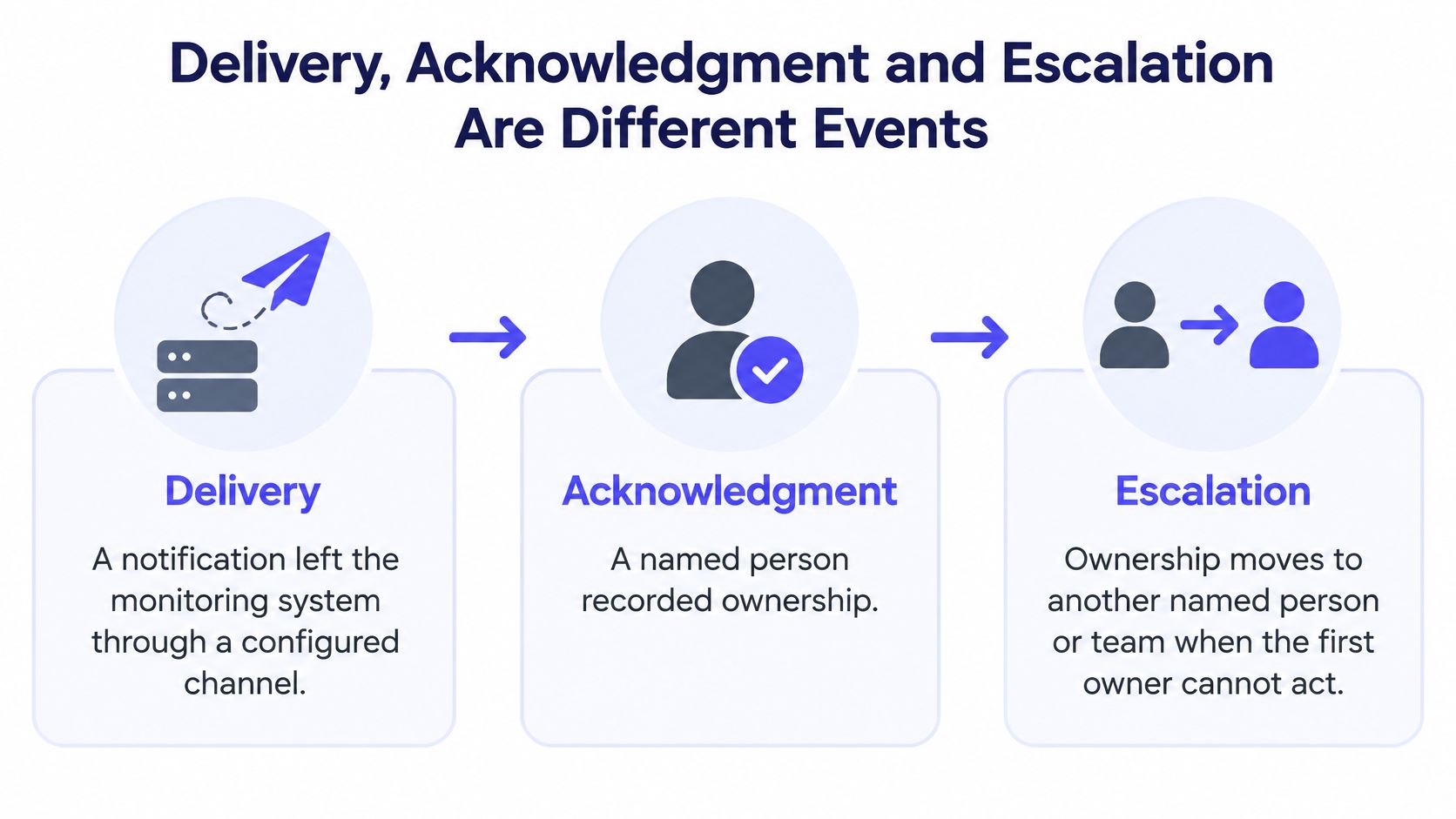
Delivery means a notification left the monitoring system through a configured channel. It doesn't establish that a responder read it.
Acknowledgment means a named person recorded ownership. Escalation engages the next responder when the current owner cannot act or an agreed response window expires.
The diagram separates those events so operators can record evidence for each.
| Event | Evidence to retain | Failure to detect |
|---|---|---|
| Detection and validation | Check reading, timestamp, scope, confirmation result | Stale data or an unverified symptom |
| Delivery | Available notification history and channel result | Rejected, misrouted, or unsupported delivery |
| Acknowledgment | Named person and acceptance time in the incident log | Delivered alert without an owner |
| Escalation | Trigger, contacted responder, acceptance time | Another notification sent without accepted ownership |
| Client update | Message, recipient, send time, next update due | Technical response without business communication |
Fivenines confirms uptime failures across regions before paging the user. That product behavior shouldn't be assumed for every host or custom check; any additional confirmation required by the runbook needs an explicit source and procedure.
In a 2025 survey of 80 North American MSPs, more than 75% reported alert fatigue at least monthly, according to Channel Insider's account of the Heimdal survey. More recipients and repeated messages aren't substitutes for priority and ownership.
Keep unsupported automation manual
The real-time alerting guide provides additional alerting context. If a required channel or escalation action isn't established in the selected plan, assign it as a manual task rather than promising automation.
The accompanying video provides another reference for the incident workflow.
Copy-Ready Shift Handoff Template
The handoff note must let the next operator continue without reconstructing the incident from chat. CISA's Logging Reference Architecture identifies useful alert context including detection type, source tool, affected asset or resource, timestamp, severity, and explanatory analytic context.
Shift handoff template fields
All example entries below are hypothetical, including the fictional client, people, assets, and times.
| Field | What to write | Example entry (hypothetical) |
|---|---|---|
| Client and scope | Client name, hosts, and services covered | Northwind Dental, 3 Proxmox nodes and practice-management application |
| Active alerts | Alert type, source tool, asset, first-seen time, severity, state | Quorum alert; cluster check; node 02; 02:14 UTC; P2; open; guest reachability also affected |
| Owner | Named primary and backup | Ana, primary; Ravi, backup |
| Acknowledgment | Time and person who acknowledged | 02:19 UTC, Ana |
| Actions taken | Read-only checks first, then changes with rollback notes | Cluster state checked; no changes made |
| Open hypotheses | Each guess marked unverified, with planned test | Unverified: storage path may be slow; compare storage and switch records |
| Client message | Last update sent and next update due | 02:45 UTC: application disruption under investigation; next update 03:15 UTC |
| Next handoff | Pending work, rollback notes, and incoming owner | Await switch vendor response; Ravi to accept ownership explicitly; no change to roll back |
Separate evidence from interpretation
An observation is a reading with a timestamp and source. A hypothesis is an unverified explanation paired with a planned test. “Storage latency increased” and “the switch rebooted” belong in different fields unless device evidence establishes the latter.
The template requires an incident or PSA record, synchronized timestamps, read-only access to relevant telemetry, and a named receiving operator. Missing evidence should be written as “not available,” with an owner assigned to obtain it, rather than omitted.
The platform has no native connectors for ConnectWise, Autotask, HaloPSA, or SuperOps. Copy the note manually or through an independently maintained process; don't assume an automatic PSA handoff exists.
Acceptance check: The incoming operator should be able to identify the current owner, the next safe action, and the next client update without opening a separate conversation.
Paste the completed template into the PSA ticket and retain a copy with the incident record.
A Hypothetical Incident Split Into Observations and Hypotheses
This hypothetical incident concerns fictional Northwind Dental, running three Proxmox nodes and a practice-management web application. Every time, reading, and action below is illustrative; no real customer incident or test execution is described.
The scenario assumes configured cluster, guest, storage, and application checks. Operators need read-only access to those readings and approved access to switch logs; actual software and firmware versions must be recorded in the incident before applying version-specific diagnostics.
Hypothetical incident timeline
| Time (UTC, illustrative) | Observation or action | Source | Status |
|---|---|---|---|
| 02:14 | Node 02 left cluster quorum | Cluster check reading | Observed |
| 02:16 | Two guests on node 02 show unreachable | Guest state reading | Observed |
| 02:19 | On-call engineer acknowledged the P2 alert | Incident log | Recorded |
| 02:24 | High storage latency on one pool | Storage latency reading | Observed |
| 02:27 | Suspected switch reboot explains both symptoms | None yet | Hypothesis; test needed |
| 02:45 | Initial client update sent | Ticket record | Recorded |
Observed means a source produced a reading. Recorded means a process event occurred. Hypothesis requires a test, while Verified requires confirming evidence, such as a device log establishing the relevant uplink failure. None of the listed observations verifies a switch reboot.
Diagnose without turning a guess into a change
The NOC operator compares timestamps, checks whether the affected guests share a network path, and requests switch records. Missing switch logs leave the cause unverified; storage latency alone doesn't establish a network cause.
The MSP engineer makes no change until the uplink outage is confirmed. Any subsequent state-changing action requires authorization, a recorded starting configuration, a safe validation procedure, and a rollback plan. Restarting the switch merely to test the hypothesis would destroy useful evidence and could widen the outage.
A running guest doesn't prove application availability. The application needs its own probe checking an expected application response, and the runbook must establish what the configured quorum check reports.
At 02:45 UTC, illustrative, the client message states the observed disruption and investigation status without asserting a cause. It promises the next update at 03:15 UTC, illustrative, even if diagnosis remains incomplete.
The incident report writing guide helps turn that evidence trail into a final report without presenting suspicions as root cause.
What an MSP NOC SLA Can and Cannot Promise
A NOC SLA describes measurable operational commitments, not guaranteed recovery from every failure. ConnectWise's NOC guidance cites a 2025 industry survey in which fewer than one-third of MSPs had a full-service NOC or data center, so continuous coverage shouldn't be interpreted as proof of a staffed facility.
NOC SLA scorecard
| Measure | What it proves | Who records it | What it does not prove |
|---|---|---|---|
| Alert ingestion availability | The monitoring system received the signal | Monitoring platform | A human saw the alert |
| Acknowledgment time | A named engineer took ownership | Incident log | The fix has started |
| Escalation time | The next owner was engaged on schedule | Escalation record | The client was told |
| Client update cadence | Updates were issued through the agreed channel, with receipt evidence where available | Ticket or status page | The problem is resolved |
| Remediation responsibility | The party owning the fix is named | Contract and runbook | The fix is correct |
| Maintenance exclusions | Windows when alerts were suppressed | Change calendar | Nothing relevant was hidden |
| Evidence retention | The agreed duration for keeping readings and logs | Contract and retention policy | Root cause is known |
The contract must enumerate covered servers, SNMP devices, websites, APIs, jobs, databases, and virtualization resources, then explicitly list exclusions. Retention and plan limits belong in the current agreement, not assumptions copied from another client.
An agent failure, blocked network path, expired credential, or failed notification channel needs a separate monitoring-incident procedure. That procedure should identify how operators detect missing data and communicate when the normal notification path is unavailable.
Hosting dependencies belong in scope too. Power issues accounted for 45% of respondents' most impactful data-center outages in Uptime Institute's 2025 survey, supporting named hosting-provider and facility escalation contacts.
Validate the contract with a bounded pilot
The SLA monitoring guide provides additional measurement context. Before expanding coverage, the service owner should run this pilot:
- Review capabilities: Read the current workflow feature documentation against the proposed plan and runbook.
- Limit scope: Connect one authorized client host or one HTTPS check, using least-privilege access and a non-production notification contact.
- Confirm readings: Compare telemetry with a known state. Record unavailable readings as missing, not healthy.
- Exercise the handoff: Send one safe test alert without interrupting production. Record delivery, acknowledgment, and escalation evidence in the template.
- Reconcile results: Compare recorded times with the contract. Fix routing, access, and ownership failures before adding hosts.
The MSP monitoring solution page is a relevant next step for evaluating the monitoring layer against that pilot. A successful alert test still doesn't replace the runbook, escalation agreement, or human incident judgment.
Fivenines offers unified production-infrastructure monitoring, not staffed NOC operations. Visit Fivenines to evaluate one host or HTTPS check, verify useful readings, and test a safe notification with the named responder before expanding client coverage.