Recovery Time Objective: A Practical Guide for 2026


The alert arrives before dawn. A production service is failing, dashboards are red, and the on-call engineer is trying to restore customer access while everyone asks the same question: how long can this stay down? The continuity plan has an RTO, but nobody knows whether its clock starts at the first failed transaction, the alert, or the moment someone declares an incident.
That ambiguity matters more than the number in the plan. A recovery time objective only helps when teams can measure it from a clearly defined disruption to a verified business outcome. Otherwise, it's a promise without evidence, and an untested recovery procedure can leave customers waiting while infrastructure appears healthy.
Table of Contents
- The 3 a.m. Wake-Up Call
- What a Recovery Time Objective Means
- Tiering Workloads by Business Impact
- Decomposing an RTO into Measurable Stages
- Why Most RTOs Fail on the Day It Matters
- Choosing a Recovery Architecture That Matches the Target
- Monitoring, Automation, and Runbooks That Actually Shorten RTO
- A 90-Day Plan to Make Your RTO Real
The 3 a.m. Wake-Up Call
The primary database is unreachable. A failover begins, but the application still can't serve requests because its authentication dependency is down. The runbook says to redirect traffic, yet the person on call isn't sure whether the secondary environment has current credentials. Every minute spent resolving those unknowns consumes time the business assumed was available for recovery.
That's the practical problem a recovery time objective (RTO) is meant to address. It sets the recovery window an organization can tolerate before disruption causes unacceptable effects on its mission or business processes. NIST frames RTO as an outcome of business-impact analysis, not the time needed to restore a backup or restart a server (NIST's definition of recovery time objective).
In production, “the server is up” is not the same as “the service is back.” Customers may still be unable to log in, complete a payment, or retrieve the data they need. The recovery clock is only stopped when the agreed service outcome has been verified.
A number in a continuity plan describes an intention. A timed drill shows whether the team can meet it.
An untested RTO hides questions that become urgent during an outage. Can monitoring detect the failure? Does the right person receive and acknowledge the alert? Are dependencies recoverable in the right order? Can the team validate the customer workflow before declaring success? If nobody has tested those steps, the stated target may reflect hope rather than capability.
That gap affects more than the on-call engineer. Business owners need to know when work can resume, customers need reliable service, and technical teams need a target that shapes architecture and recovery procedures. A credible objective connects those needs to evidence from actual recovery exercises.
What a Recovery Time Objective Means
A recovery drill can produce several plausible finish times: when the team detects the outage, when payments resume, and when the entire service returns to normal. Only the agreed business outcome determines whether the recovery time objective has been met. Recording those checkpoints makes the result easier to assess.
The RTO defines how long system components may remain in recovery before disruption negatively affects the organization's mission or business processes, as NIST's glossary definition explains. Business owners and operators need a shared completion condition: which workflows must work, what reduced service is acceptable, and what validation proves recovery.
Minimum viable service and full restoration can be different checkpoints. Restoring payment processing while reporting remains unavailable may satisfy an agreed payment-service objective. It also leaves recovery work outstanding. Define that boundary before an incident, then use drills to check whether the expected recovery window matches observed performance.
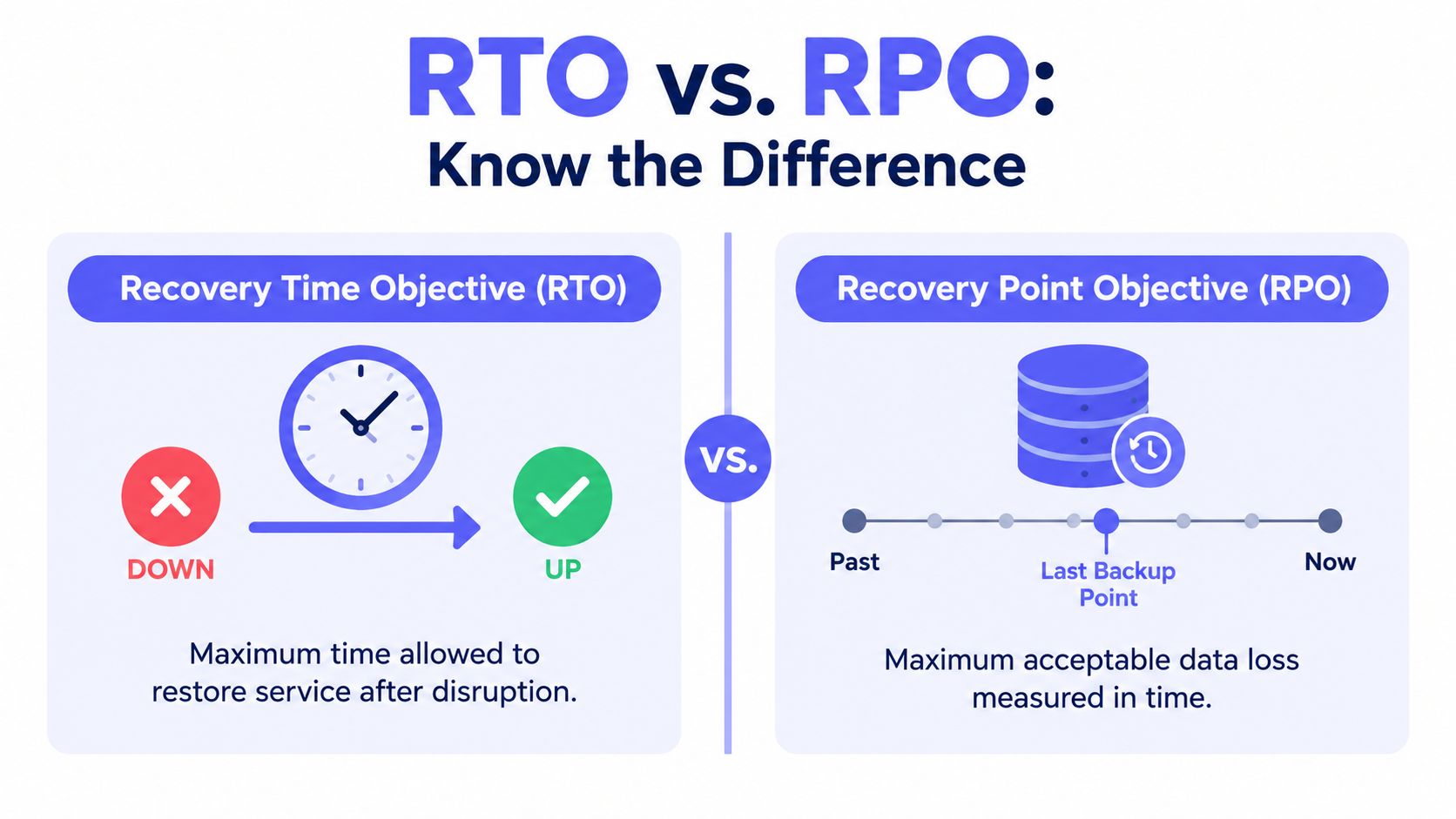
RTO is distinct from three related measures. Recovery point objective (RPO) concerns tolerable data loss expressed as elapsed time. A service-level agreement (SLA) records contractual customer commitments. Mean time to recover or restore (MTTR) summarizes observed recovery performance across incidents. An average can conceal a recovery that exceeded the business limit.
RTO vs. RPO, SLA, and MTTR
| Metric | What it answers | Unit | Set by |
|---|---|---|---|
| RTO | How soon must service be restored to avoid unacceptable business impact? | Elapsed time | Business owners, informed by impact analysis |
| RPO | How much recent data loss can the business tolerate? | Elapsed time of data loss | Business and data owners |
| SLA | What service commitment has been made to a customer? | Contract-defined service terms | Provider and customer |
| MTTR | How long does recovery take in practice? | Observed elapsed time | Measured by operations |
One payment service, four different questions
For a payment service, RTO sets the acceptable interruption, while RPO limits how much transaction history may need reconstruction. The SLA defines the customer commitment. MTTR summarizes how long recovery has taken; individual incident and drill timings show whether this recovery met its objective.
Keep the results separate.
A fast restore can still breach the data-loss limit or miss a contractual commitment. Recovering sooner by accepting reduced functionality also requires business agreement about what customers can do. Report detection, validated minimum service, and full restoration alongside data loss and the relevant commitments. That makes the expectation-versus-reality gap visible without letting a green infrastructure dashboard stand in for business recovery.
Tiering Workloads by Business Impact
A defensible RTO starts with business impact, not with the recovery method a team already owns. NIST's framing makes the target specific to the process and its consequences. That means two applications in the same environment can have different RTOs because one supports a time-sensitive customer workflow and the other supports work that can wait.
AWS recovery-planning guidance offers representative tiers as benchmarks, not universal requirements. Mission-critical Tier 1 workloads may target an RTO of about 15 minutes with near-zero RPO. Important Tier 2 workloads may use an RTO of about 4 hours and an RPO of 2 hours. Lower-priority Tier 3 workloads may accept an RTO of 8–24 hours and an RPO of 4 hours (AWS recovery-objective planning guidance).
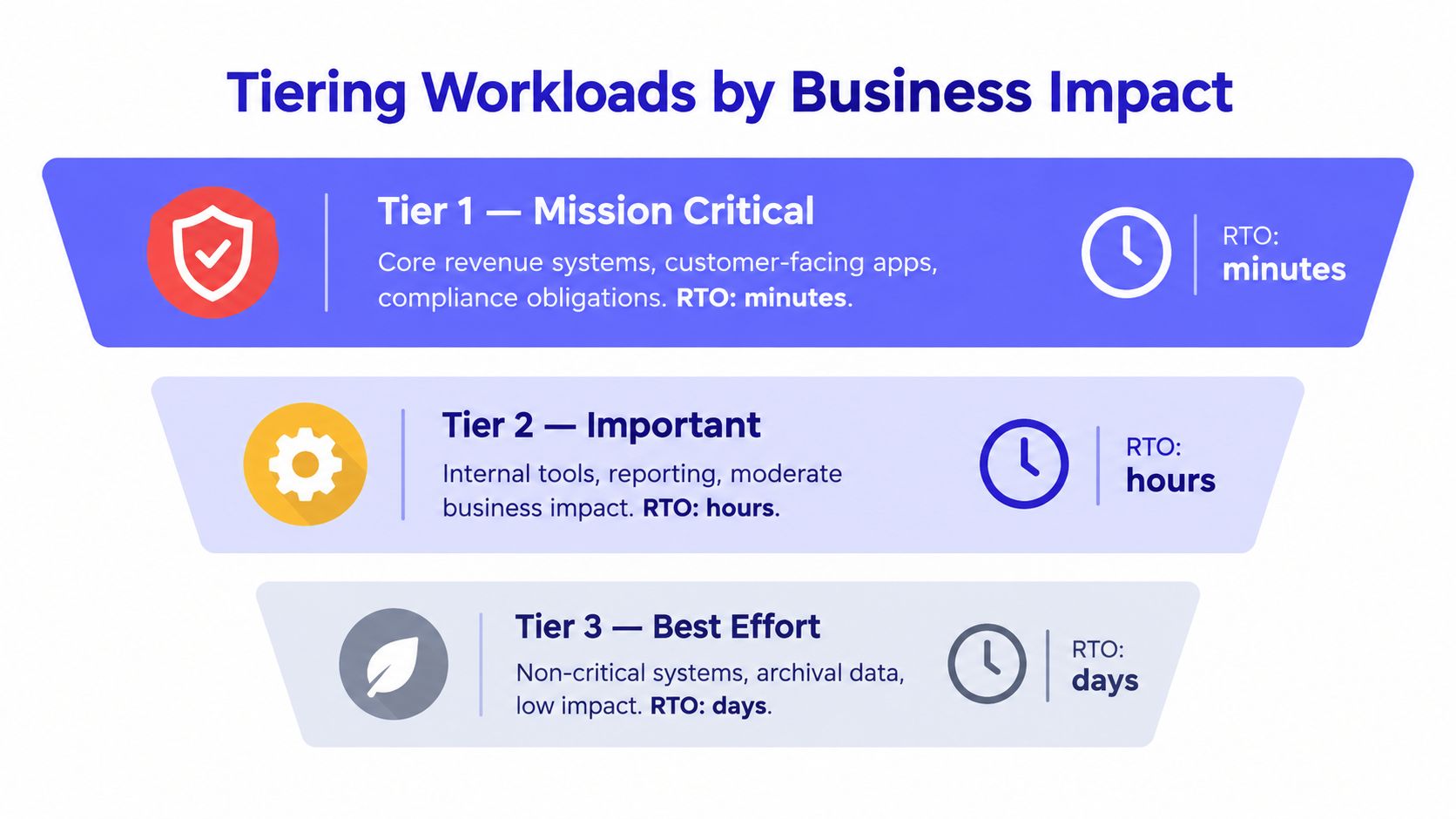
The tier labels help organize a discussion, but they shouldn't replace it. A payment workflow might justify a short objective because interruption quickly affects customers and business operations. A reporting workload may tolerate a longer interruption if teams have a workable alternative. The target should reflect the consequences of delay, not a desire to classify every application as critical.
Build the rationale before choosing the number
Business and technical owners should document the inputs behind each tier:
- Financial exposure: What operational or commercial effects grow as the service remains unavailable?
- Customer impact: Which customer actions become impossible, and how quickly does that matter?
- Regulatory and contractual obligations: What external requirements affect recovery priorities?
- Dependencies: Which identity, data, network, supplier, or platform services must recover first?
- Manual workarounds: Can staff continue operating temporarily, and what are the workaround's practical limits?
Record the service owner, dependencies, proposed RTO and RPO, recovery assumptions, and rationale in one place. If stakeholders disagree, the disagreement is useful: it can reveal that they're discussing different outcomes, such as basic internal access versus complete customer functionality.
A tier is a prioritization decision, not a permanent label. When business impact, dependencies, or recovery capability changes, owners should revisit the target. Teams can also relate recovery targets to service objectives in their broader reliability practice, using a shared vocabulary for expectations and operational performance (service-level objectives and their role in reliability).
Decomposing an RTO into Measurable Stages
The database is back, but customers still cannot complete a payment. Stopping the recovery clock there would hide the outage that matters to the business. Start timing when disruption begins, then track detection, triage, minimum viable service, and full restoration against agreed completion conditions.
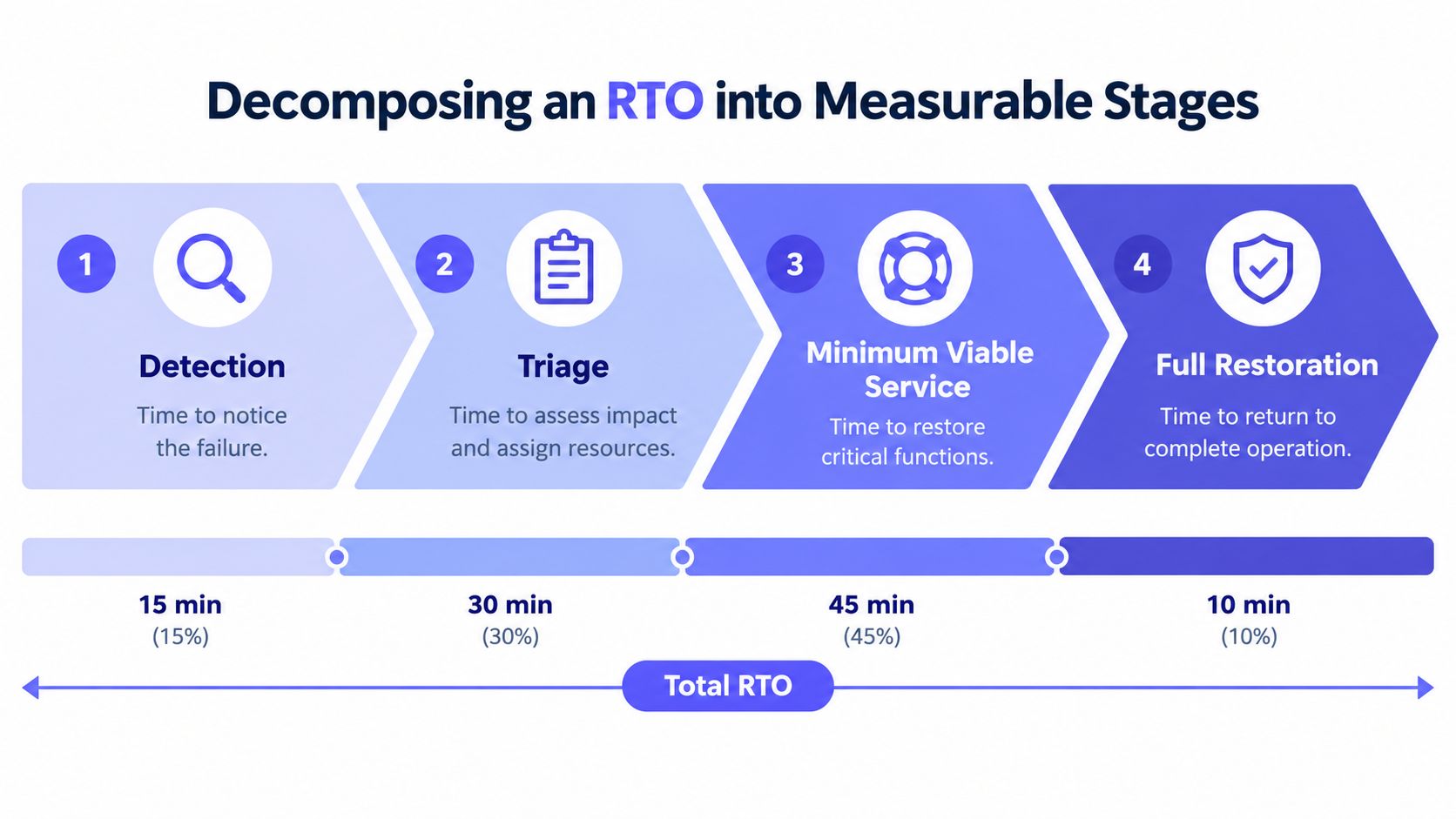
Each checkpoint needs an observable result:
- Detection: Monitoring confirms that the failure has impaired service.
- Triage: The responsible team acknowledges the incident, establishes impact, and selects a recovery action.
- Minimum viable service: The critical customer or business workflow passes its agreed check.
- Full restoration: Remaining functions and dependencies return and pass validation.
Budget for the work between those checkpoints: failover or restoration, data recovery or synchronization, dependency startup, traffic redirection, and application checks. Some tasks can overlap. Record their elapsed times anyway, so a slow approval does not disappear inside a broad “restore” measurement.
Test the clock against a real workflow
Consider an example using the representative Tier 1 benchmark introduced earlier: a 15-minute target with 10 minutes consumed by monitoring, alert delivery, and human approval leaves 5 minutes for recovery and validation. Whether a service can meet that target depends on its full recovery path, consistent with AWS recovery-objective planning guidance.
Waiting consumes the same budget as restoration.
Define completion in user terms. A payment service might require a successful test transaction through the customer-facing path. An internal tool might require a staff member to authenticate and complete a core task. Specify which workflow qualifies as minimum viable service and which checks remain for full restoration. Accepting reduced functionality can shorten business disruption, but owners must agree on what remains unavailable.
Practical rule: Measure from disruption to verified function. Record infrastructure recovery as a checkpoint, not as the finish line.
Compare checkpoint timings from drills with the allocated budget. The gap identifies where recovery needs improvement: earlier detection, faster decisions, or less restoration work. Use mean time to recovery to track observed duration, while retaining stage timings to explain it.
The embedded video is supplementary; use the workflow checks above as the completion criteria for your own service.
Why Most RTOs Fail on the Day It Matters
The restore finishes, but responders cannot redirect traffic because the required credentials are unavailable. The recovery diagram looked complete. The drill exposes the missing step that keeps customers waiting.
Survey findings in the 2025 State of Backup and Recovery report show the expectation gap: more than 60% of respondents believed their organizations could recover in under a day, while 35% said they could; for public-cloud data, around 40% expected recovery within hours, while 11% reported recovery within minutes.
These figures describe the industry, not your team, which is exactly why the gap between intended and demonstrated recovery must be measured locally.
Backup integrity, dependency order, credentials, capacity, DNS changes, and escalation paths can all remain untested behind a convincing plan. Each unresolved assumption becomes work responders must perform during the outage.
Turn assumptions into drill evidence
Run the exercise from the failure signal through the actual recovery path. Require responders to use the documented decision process, restore infrastructure and data, redirect traffic, and verify the application. Record detection, minimum viable service, and full restoration separately so a successful restore cannot conceal continued business disruption.
Capture manual interventions and failed assumptions alongside checkpoint timings. A tabletop exercise exposes unclear ownership and decision authority. A timed technical drill establishes whether configuration, access, data, and dependencies are available under the tested conditions. Scheduling that drill takes operational effort, but skipping it leaves the recovery target unsupported.
Use those results to set RTO confidence. High confidence requires demonstrated completion with critical dependencies included. Low confidence means the objective still exceeds the available evidence. Assign owners to failed steps and retest them; these incident-response practices can help clarify the surrounding response process.
AI-assisted recovery tools may reduce manual work. The same industry report found typical RTO improvements of 11%–25% among surveyed organizations using AI-powered recovery tools. Treat those reported gains as a reason to test, rather than credit against your recovery budget. Verify restored data, application behavior, and customer workflows in a timed exercise before relying on any claimed improvement.
Choosing a Recovery Architecture That Matches the Target
A standby environment can be running while customers still cannot complete a transaction. Recovery architecture earns its cost when it restores the business service within the target. AWS describes four broad patterns: backup and restore, pilot light, warm standby, and multi-site active/active (AWS disaster-recovery patterns). Keeping more capacity and service state ready can shorten recovery, but increases spending and operational work.
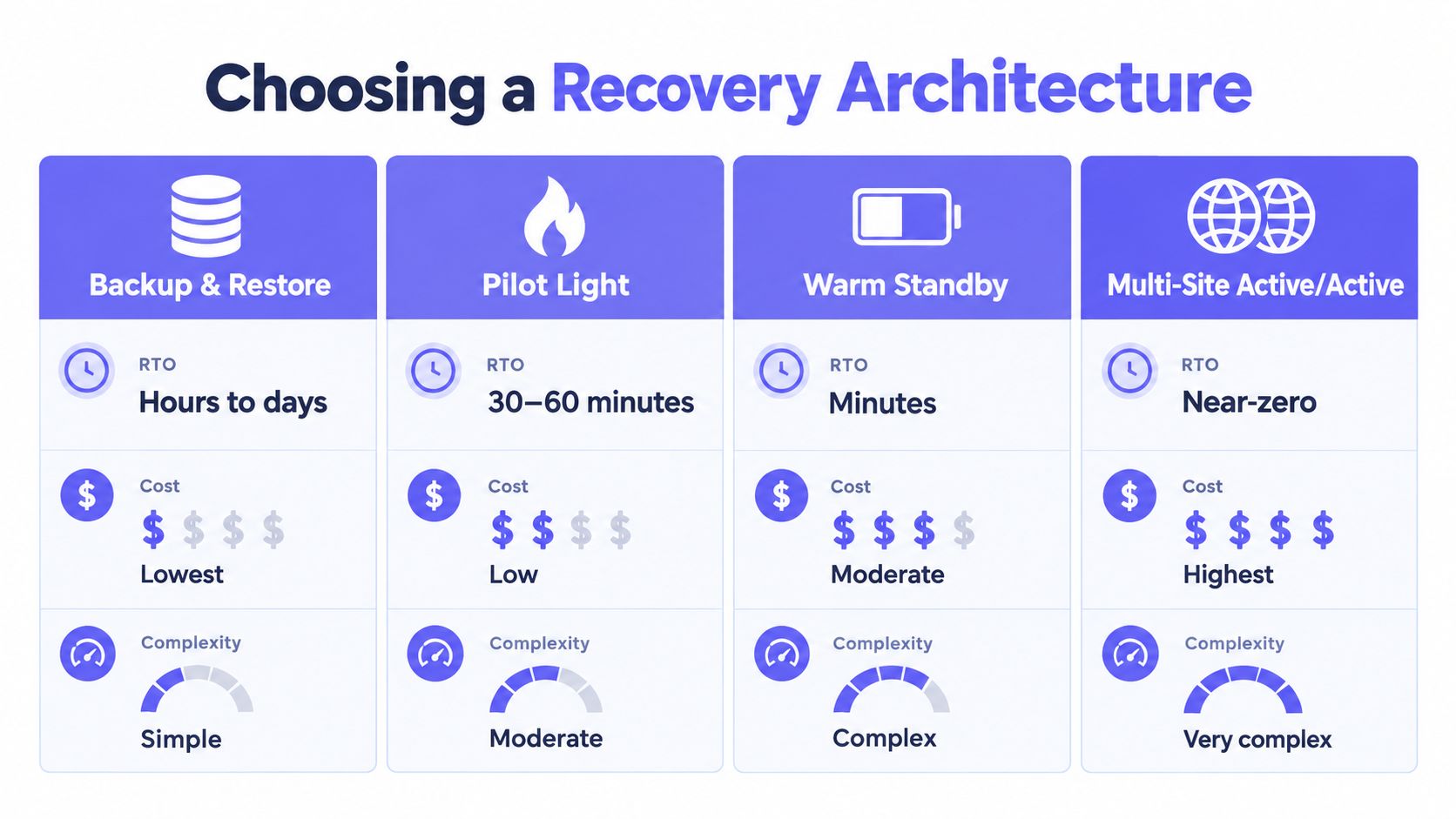
Backup and restore suits workloads that tolerate the time needed to rebuild infrastructure and restore data. Pilot light keeps core components available, leaving provisioning and scaling on the recovery path. Warm standby maintains a more complete environment at reduced capacity, so capacity expansion still matters. Multi-site active/active supports rapid continuity across operating sites, with greater architectural and operational demands.
Choose the simplest pattern that demonstrates the required business outcome.
Lower-priority workloads may justify backup and restore; tighter targets may justify standby capacity. Compare designs against detection, minimum viable service, and full restoration separately. A warm standby that resumes a critical workflow within the target may be sufficient even if full capacity takes longer, provided that distinction matches the business requirement.
Check the recovery path against the target
Stale configuration, missing credentials, unverified replication, incomplete runbooks, and forgotten traffic changes can defeat an otherwise suitable design. Regular failover tests expose these failures before production outages, as the AWS patterns paper recommends.
Use the expectation-versus-reality gap to decide what to fund. If approvals consume the recovery window, resolve decision authority before buying more standby capacity. If data restoration dominates, test a different recovery method or replication path. If reduced capacity cannot support the minimum viable service, the standby sizing needs attention.
The least costly suitable architecture is the one that meets the target under tested conditions, including the customer workflow that defines restored service.
Monitoring, Automation, and Runbooks That Actually Shorten RTO
A recovery clock gets shorter when teams remove delays from the stage that consumes the most time. Monitoring should detect service failure from outside the affected environment as well as inside it. Multi-region uptime checks, dependency-aware alerts, and failure confirmation can help distinguish a genuine outage from a noisy signal before responders are paged.
Runbooks should make the next action clear without relying on one engineer's memory. Keep dependency order, decision ownership, access requirements, recovery commands or automation, and validation steps current. Treat runbooks as code where possible: review changes, test them during exercises, and record which versions responders used.
Match operational capability to the checkpoint
For detection, measure from failure to confirmed signal. For triage, track alert delivery and acknowledgement. For minimum viable service, automate repeatable failover and restoration steps while keeping a human decision point where business risk requires it. For full restoration, use checks that validate application behavior and critical dependencies, not only host health.
A monitoring stack such as Prometheus, Grafana, and Alertmanager can provide strong visibility, but teams still need to connect metrics, alert routing, uptime checks, and customer communication. A consolidated platform can reduce that integration work. Fivenines combines infrastructure metrics, multi-region uptime checks, alert routing, status pages, and monitors managed through a Terraform provider and REST API. Those capabilities can support detection, escalation, and customer updates, while drills remain necessary to prove recovery performance.
Status pages and incident workflows can also take routine coordination off the responder's plate. Automated routing, delays, retries, and escalations help alerts reach the right people, while a published customer-facing status page gives the incident team a place to communicate service state. The broader operational practices in this guide to incident management automation can help teams decide which response steps are suitable for automation.
A 90-Day Plan to Make Your RTO Real
A small platform team can turn an untested objective into a measurable recovery practice with a sequenced plan:
- Weeks 1–2: Run a business-impact analysis with process owners. Assign workload tiers, document dependencies and workarounds, and agree on each service's RTO, RPO, and verified completion condition.
- Weeks 3–6: Map recovery dependencies for the highest-priority workloads. Draft or update runbooks, assign decision owners, and hold a tabletop exercise to find gaps before a technical drill.
- Weeks 7–10: Run timed recovery exercises. Record detection, triage, minimum viable service, and full restoration milestones, then document failures and assumptions that need testing.
- Weeks 11–13: Automate the bottleneck exposed by the drills, publish a status page if customer communication needs a clear channel, and set a recurring exercise cadence. Revisit targets whenever business needs or recovery assumptions change.
An RTO isn't a document to finish and file. It's an operational claim that teams need to check against the service customers use. Choose one critical workflow, define what recovered means, and schedule its first timed drill.
Fivenines brings infrastructure monitoring, multi-region uptime checks, alerting, and status pages into one platform, with monitors manageable through Terraform and its REST API. Put those capabilities to work on the detection and communication parts of your recovery plan, then visit Fivenines to see whether it fits your team's monitoring needs.