Incident Management Automation: A Practical Guide

At 3 a.m., a production disk fills up. The monitoring system reports filesystem pressure, the uptime checker reports a failing endpoint, and a log platform raises a related error. Three tools create three notifications, but none explains whether they describe one failure or three. The on-call engineer wakes up, searches for ownership, checks recent deployments, finds the runbook, and starts coordinating manually while the service remains degraded.
That sequence is the problem incident management automation should solve. The objective isn't just to page someone faster. It's to turn a raw signal into a well-formed incident with evidence, ownership, context, controlled action, and a clear human escalation path.
Table of Contents
- What Is Incident Management Automation
- Why Automation Matters for DevOps and SRE Teams
- Core Components of an Automated Incident Pipeline
- A Real Workflow From Monitoring to On-Call Response
- When Automation Should Stop and Ask a Human
- Fixing the Real Bottleneck Before Adding More Alerts
- Best Practices for Implementing Automation Safely
What Is Incident Management Automation
Incident management automation uses software to detect, correlate, enrich, route, and respond to service failures without requiring a person to coordinate every step. Simple alerting says that something crossed a threshold. Automation determines whether the signal is credible, whether other alerts belong to the same event, which team owns the affected service, what evidence matters, and what action is safe.
An air-traffic-control tower is a useful comparison. Controllers remain responsible for decisions, but systems track aircraft, maintain separation, surface conflicts, and coordinate communication. In production operations, engineers stay in command while automation handles repetitive movement through the incident workflow.
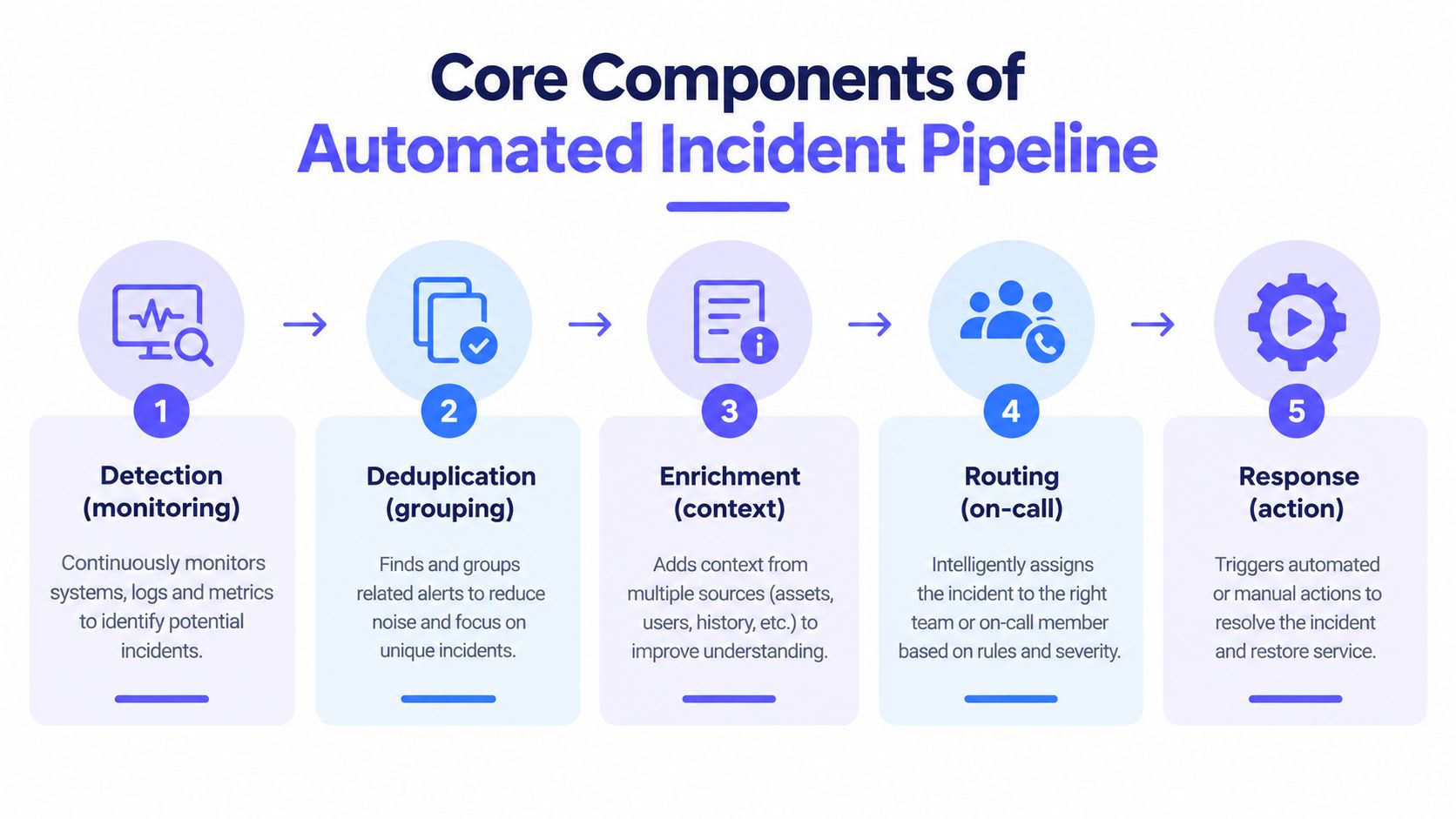
A useful pipeline has five layers:
- Detection: Monitoring identifies a possible failure and confirms it through relevant checks.
- Correlation: Related alerts become one incident instead of an alert storm.
- Context: The incident receives service ownership, dependencies, recent changes, severity, and runbook references.
- Coordination: The platform routes the incident, starts escalation timers, and sends stakeholder updates.
- Response: A bounded runbook performs a reversible action, verifies the result, or stops and asks for approval.
This distinction matters because automation isn't synonymous with automatic remediation. A workflow that creates a ticket or sends a Slack message is automated coordination. A workflow that restarts a process is automated response. Both can be valuable, but they carry different operational risks.
Teams comparing incident workflows with broader process orchestration can also review workflow automation fundamentals to separate event-driven coordination from general business automation.
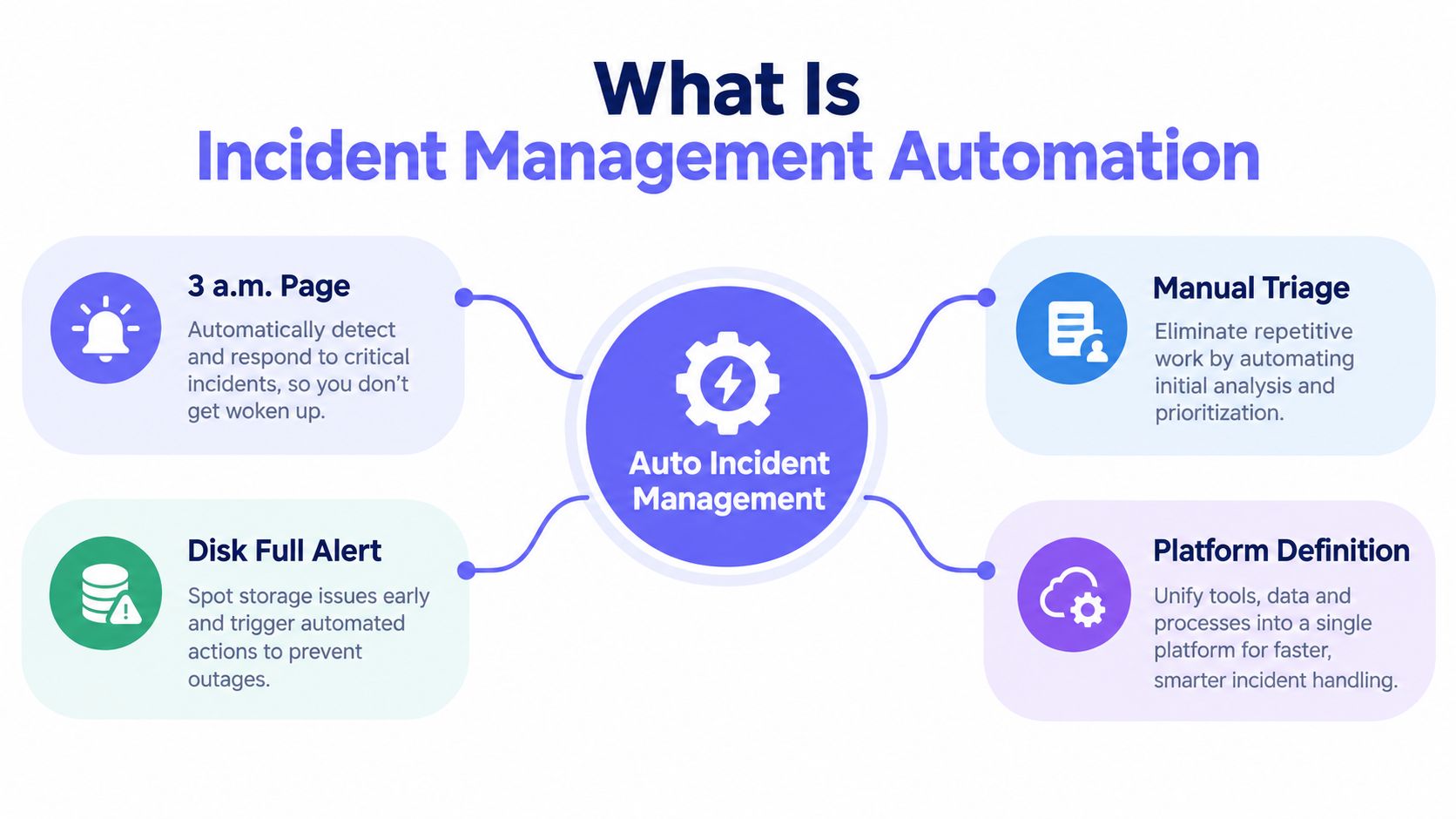
The practical test is straightforward: after an alert fires, can the system explain what happened, who owns it, what has already been tried, and why it escalated? If the answer is no, the stack may have alert automation, but it doesn't yet have dependable incident management automation.
Why Automation Matters for DevOps and SRE Teams
At 02:00, a dependency starts timing out. The alert fires, but the hard work begins afterward: identifying the affected service, finding the owner, separating related symptoms, and deciding whether anyone should take action. Manual handling breaks down when the failure occurs outside staffed hours, several services degrade together, or the first responder lacks access and context. Each handoff adds delay, and manually chosen escalation paths can vary from one incident to the next.
Outages are routine operational risks. Uptime Institute's 2021 Annual Outage Analysis reported that approximately three out of four surveyed data-center operators and enterprise IT managers had experienced some form of IT service outage during the preceding three years, while about three in ten had experienced an outage with significant impact (Uptime Institute's Annual Outage Analysis). Its longer historical dataset found that electrical failures accounted for 80% of all IT-load losses in data centers. Monitoring therefore needs infrastructure coverage alongside application signals.
A 2022 survey found that 48.2% of respondents viewed automation as a way to reduce MTTR, while 52.3% planned to implement new automation tools or applications (2022 SRE automation survey coverage). The survey also reported different incident patterns: 29.4% of organizations relying mainly on operations teams experienced 20 or more major incidents during the previous 12 months, while 38.2% of organizations expanding SRE practices reported fewer than five major incidents.
Operational principle: Automation earns its place by removing coordination delay; more notifications is not a deliverable.
For an SRE team, useful automation connects monitoring with ownership metadata, escalation policy, bounded remediation, and post-incident records. An MSP can apply consistent routing across client environments without requiring engineers to remember every customer preference. A hosting provider or solo operator can maintain response coverage when nobody is watching a dashboard.
Service objectives set the policy boundary. Teams that define an effective service-level objective can connect severity and escalation to user impact, then reserve human attention for breaches that warrant it.
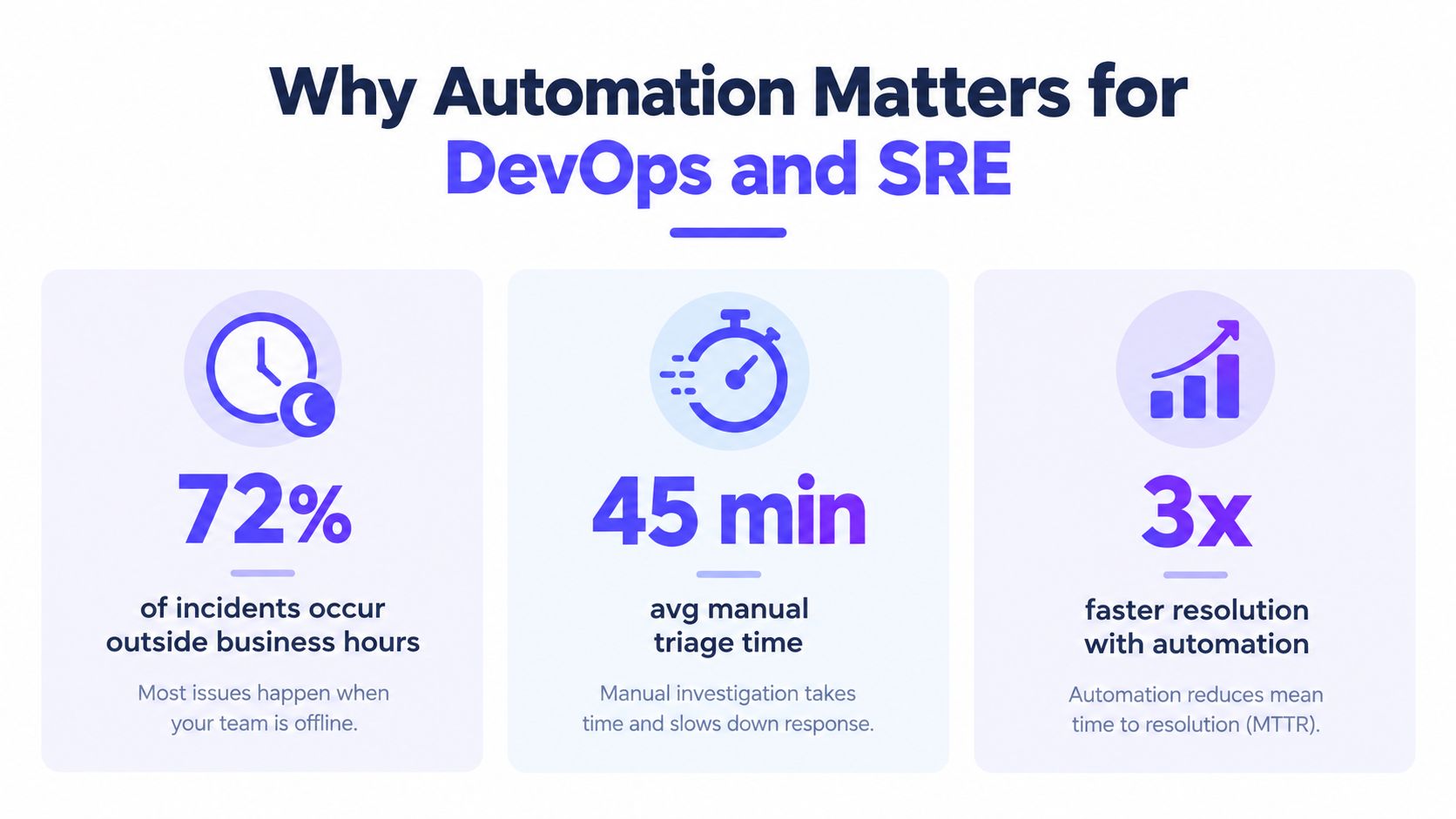
The business case extends beyond productivity. Automated context gathering, deduplication, ownership routing, and carefully bounded recovery give teams a clearer operational record while preserving human control when evidence is incomplete or the action carries material risk.
Core Components of an Automated Incident Pipeline
A reliable pipeline behaves like a chain. If one link is weak, the next stage inherits a misleading or incomplete signal. The essential components are detection, deduplication, enrichment, routing, escalation, and runbooks, with the causal record preserved from the original alert through the final outcome.
Detection confirms that a failure is real
Detection starts with telemetry, but a threshold alone isn't always enough to justify a page. A CPU spike may resolve before anyone needs to act. A failed HTTPS check from one location may reflect a transient network path rather than a customer-facing outage. Confirmation logic, rechecks, maintenance windows, and related signals help distinguish an incident from noise.
Outages can originate in power, hardware, networking, cloud infrastructure, dependencies, or application code. Monitoring that covers only application logs leaves the response blind to other failure classes.
Deduplication turns symptoms into incidents
One failing database can trigger application errors, latency alerts, queue warnings, and synthetic-check failures. Without correlation, every symptom becomes a separate page and several responders investigate the same event.
Deduplication should group alerts using shared service, dependency, time window, topology, and failure signature. The result should be one incident timeline containing the related evidence, not a discarded pile of alerts. Teams designing this layer can use event correlation practices as a reference point, but correlation rules still need review against the actual service architecture.
Enrichment gives responders a starting point
A page that says “checkout unhealthy” forces the responder to reconstruct the system. Enrichment should attach the owning team, service criticality, dependency relationships, recent deployments, relevant dashboards, and the runbook that matches the failure mode.
Routing and escalation make responsibility explicit
Routing sends the incident to the team that can act. Escalation should begin only when there's no acknowledgment, no diagnostic progress, no mitigation attempt, or no recovery verification. A fixed schedule that pages larger groups without checking progress creates noise and obscures responsibility.
Runbooks turn knowledge into controlled action
A runbook may be a documented procedure or an executable workflow. Either way, it should define preconditions, the permitted action, verification criteria, rollback behavior, and the conditions that require a human.
Every stage should preserve the same chain: alert, evidence, correlation decision, owner, action, verification result, and escalation reason. Without that record, post-incident review becomes a reconstruction exercise, and the automation can't be trusted to make the next decision.
A Real Workflow From Monitoring to On-Call Response
Consider a production Linux server hosting an API. Its disk usage rises, the API begins returning errors, and HTTPS checks from multiple regions fail. A dependable workflow doesn't page the on-call engineer at the first isolated symptom. It confirms the endpoint failure, compares the signals, and opens one incident with a coherent timeline.
The incident gains context before a person is paged
The monitoring layer records the filesystem condition, the failed HTTPS checks, affected regions, and the time at which the service became unhealthy. Deduplication groups those signals as one incident rather than sending separate pages for storage, availability, and application symptoms.
The system then adds the service owner, severity, dependency information, recent deployment history, and the runbook for a bounded disk-cleanup or process-recovery action. The incident goes to the owning channel, with the relevant dashboard and evidence attached. A small response group is assembled instead of inviting every engineer who might know something about Linux, networking, or the application.
An analysis of 50,000 incidents found that attaching incidents to explicit services was associated with 36% lower MTTR, while adding a seventh responder after the lowest-MTTR group of six was associated with an 18% increase in MTTR (analysis of incident service ownership and responder groups). The practical lesson is to structure ownership and responder roles before an outage, not during one.
Response design: Page the smallest group that can make progress, then widen the response only when evidence shows that the current group lacks the required expertise.
The workflow attempts a bounded recovery
Suppose the runbook checks that the target process is present, confirms that the cleanup condition is within a safe boundary, and performs a reversible action. The workflow can include a delay, a retry, and a verification check. If the API recovers, the incident records the remediation and closes after the configured confirmation. If the endpoint remains unhealthy, the workflow records the failed attempt and escalates with the original evidence intact.
A platform such as Fivenines supports this operational pattern through server monitoring, multi-region uptime checks, workflow delays, retries, escalation paths, and notifications across channels such as Slack, Microsoft Teams, Telegram, and SMS. It should be evaluated alongside the team's existing observability and on-call tools, with emphasis on whether the timeline remains auditable.
The same discipline applies when reviewing operational roles and hiring needs. A Blockchain Jobs incident-response leader listing illustrates the kind of responsibility organizations assign to people who coordinate outages, ownership, and recovery under pressure.
A replicable workflow therefore looks like this:
- Confirm: Recheck the service and compare independent signals.
- Group: Merge symptoms that share a service or dependency.
- Enrich: Attach ownership, recent changes, severity, and runbook links.
- Route: Notify the responsible team and assign explicit response roles.
- Act: Run only a pre-approved, reversible procedure.
- Verify: Confirm recovery using the same service-level signal that opened the incident.
- Escalate: Ask for human intervention when evidence is incomplete or recovery fails.
The goal isn't a silent automation layer. It's a visible operational record that tells responders what the system observed, what it tried, and why it stopped.
When Automation Should Stop and Ask a Human
Automation should stop when the next action can create a larger or less reversible failure than the original condition. That boundary must be designed before production use, because a workflow under pressure will otherwise default to whatever action its author happened to encode.
A practical graduated-autonomy policy starts with low-risk operations:
- Automatic enrichment: Add service ownership, dependency data, recent changes, dashboards, and runbooks.
- Automatic diagnostics: Collect logs, process state, health checks, and bounded telemetry.
- Approval-free reversible actions: Restart a failed process or clear a known temporary condition when preconditions are satisfied.
- Approval-required changes: Modify permissions, alter data, change networking, restart multiple services, or roll back a customer-impacting release.
- Human-only decisions: Handle ambiguous telemetry, unknown failure signatures, security-sensitive events, or actions with broad blast radius.
Consider a server whose process has stopped. The monitor confirms the service failure, and the runbook verifies that the process is not already restarting. A controlled restart can run automatically if the procedure is idempotent, has a cooldown period, and includes a health check. If the process fails again, the workflow must not repeat indefinitely. It should preserve the evidence, activate the kill switch or refusal path, and page a human with the failed verification result.
A study of autonomous cloud-remediation approaches reported approximately 50% reductions in SRE toil and incident-response time, with reaction time 20% to 40% lower than manually handled cases (study of autonomous cloud remediation). Those findings support constrained autonomy, not unrestricted self-healing.
Guardrails belong inside the runbook
Each automated action should answer five questions before execution:
- What precondition must be true?
- What is the smallest safe action?
- How does the workflow verify success?
- How does it roll back or stop?
- When does it require a human?
The policy also needs an accessible kill switch, explicit permissions, decision logging, and a tested break-glass path. A workflow that can act but can't be stopped is not mature automation.
The risk grows when teams apply the same confidence to AI-generated decisions. A global OneTrust and Sapio survey of 1,200 senior decision-makers found that 86% of organizations experienced at least one AI-related incident during the previous year, while 47% described governance programs as reactive, fragmented, slow, or manual (OneTrust and Sapio AI governance survey). Automated operations need governance at the action boundary, not only at the model boundary.
Fixing the Real Bottleneck Before Adding More Alerts
Detection speed is often blamed for slow response, but the first alert rarely contains enough information to solve the incident. Responders lose time deciding whether alerts are related, identifying the owner, finding the right channel, checking recent changes, and coordinating people who may be investigating the same symptom.
A 2026 peer-reviewed synthesis describes high alert volumes, fragmented workflows, staff shortages, cognitive overload, increased error rates, and reduced decision quality in human and AI cybersecurity integration (peer-reviewed synthesis on human and AI integration). The coordination problem is also visible in independent 2026 survey reporting, which found that 90% of senior security decision-makers cited difficulty coordinating stakeholders during an attack, 89% cited limited executive or board involvement, and 78% said visibility gaps across cloud, SaaS, and endpoints could slow detection or investigation.
That evidence changes the buying question. Instead of asking which tool pages fastest, teams should ask whether the system reduces context switching and makes responsibility explicit.
| Incident Stage | Manual Handling | Automated Handling |
|---|---|---|
| Detection | An engineer checks separate dashboards and decides whether a threshold matters. | Monitoring confirms the signal through rechecks and related service evidence. |
| Correlation | Responders compare notifications across tools and close duplicates manually. | The workflow groups related alerts into one incident timeline. |
| Ownership | Someone searches documentation or asks in chat who owns the service. | Structured service metadata routes the incident to the responsible team. |
| Coordination | Responders create channels, invite specialists, and repeat the current status. | The workflow assigns roles, opens the right communication path, and synchronizes updates. |
| Remediation | An engineer searches for a runbook and improvises under pressure. | A bounded procedure runs with preconditions, verification, rollback, and approval gates. |
| Escalation | More people are paged on a fixed schedule, regardless of progress. | Escalation responds to acknowledgment, diagnostic updates, mitigation, and verification evidence. |
More AI or more alert rules can worsen outcomes when the underlying ownership model is weak. A dependency-aware incident summary that identifies the likely blast radius is more useful than another unclassified anomaly. Stakeholders also need different information. Engineers need evidence and commands, customer support needs impact and status, and leadership needs a concise risk summary.
Teams should first define services, owners, dependencies, responder roles, and escalation conditions. They can then set up alerts with clearer operational intent instead of adding thresholds that nobody has time to interpret.
The strongest automation makes coordination boring. It deduplicates, supplies context, limits the active response group, and keeps observers informed without turning them into additional responders.
Best Practices for Implementing Automation Safely
Safe automation starts with a controlled rollout. Automate the work that adds context and consistency first, then expand into remediation only after the workflow has shown that its assumptions hold.
- Start with context: Attach service ownership, dependencies, severity, recent changes, dashboards, and runbooks before automating any response.
- Add confirmation logic: Use rechecks, maintenance windows, suppression, and correlation so transient signals do not create unnecessary incidents.
- Automate deterministic Level-1 actions: Begin with process restarts, bounded temporary cleanup, or rollback of a known-bad deployment. Keep every procedure idempotent and reversible.
- Introduce approval gates: Require human confirmation for destructive, data-affecting, permission-related, multi-service, or customer-impacting changes.
- Exercise failure paths: Test rollback, kill switches, refusal conditions, and escalation in tabletop exercises. A successful happy-path test does not prove safe operation.
- Manage configuration as code: Version monitors, workflows, ownership, and escalation policy consistently across environments through APIs or Terraform.
- Measure safe outcomes: Track automation success rate, false-remediation rate, rollback rate, and time-to-human-escalation. MTTR can improve on paper when an unsafe action shortens response time but prolongs recovery.
Apply the same discipline across application, network, hardware, cloud, and facility signals. Incident workflows should not assume that every failure begins in application code, because infrastructure dependencies can produce symptoms far from the original fault.
Platforms that expose monitors, workflows, and escalation policy through APIs or Terraform make this configuration easier to review, test, and version. Fivenines offers those interfaces, so teams can begin with enrichment and routing, then add bounded response actions once evidence, refusal conditions, and approval rules are clear.
A practical next step is to map one recurring incident, define its owner and stop conditions, and automate evidence collection and escalation before remediation. Fivenines provides monitoring, uptime checks, workflow automation, notifications, and infrastructure-as-code interfaces for that controlled pipeline.